Schemata Staff Expands to Seven

Things are picking up here, and we are pleased to announce the addition of two new staff members, bringing our total to seven (a pretty special number to many -- including us!). [caption id="attachment_965" align="alignnone" width="700" caption="Katherine (L) and Domonique (R)"][/caption]

Katherine is one of the two newest members of the Schemata Workshop team. She has gained professional experience in Seattle at Craft Architects, Coates Design, and Sclater Partners Architects. She grew up camping in the Black Hills of South Dakota, then skiing in Montana while she earned a Master of Architecture degree. Now she enjoys all the camping, hiking, fishing, and clam digging that Washington State has to offer.

Katherine has a passion for enriching lives through architecture and seeks inspiration from the user for all design decisions.  She takes pride in her ability to work diligently to meet deadlines and strives to exceed expectations. She is currently studying for the architect registration exam. When she is not studying or in the office you will find Katherine running around Capitol Hill with her boxer puppy.

Domonique is the new Office Manager at Schemata Workshop, and  brings ten years of administration expertise. Her experience includes working in the architectural, non-profit, insurance, and construction fields.  She grew up in the Northwest, and received her Economics degree from the University of Washington.  In addition to supporting the Schemata Workshop team Domonique started a small business, Edible Dirt, where she provides urban citizens the coaching, inspiration, and community support to start growing their own produce.

Rain or shine Domonique can probably be found outside training for some kind of endurance race. She finished her first half Ironman last summer and is working towards her goal of an Ironman in 2012. In the meantime she is headed to Zürich in April for her second marathon.  After a long day Domonique can be found curled on the couch with her favorite buddy, a Portuguese Water Dog puppy named Goose.

Eltana Bagels -- Because it's a Long Way to Montreal

There is something quintessentially urban about the bagel, at least that's my own romantic musing. Perhaps its Eastern European, Jewish origins make it somewhat exotic, or maybe it brings up memories of the East Coast and its larger metropolises. Better yet, it is probably because it is only in a city that one can hope to find a decent one! Sold in super markets and bakeries alike, most bagels (in both cities and suburbs) are based on the misconception that if you use bread dough, form it into a circle, and put a hole in it -- you have a bagel. City dwellers have generally experienced better, except for those of us living on Capitol Hill, where, much to my chagrin, we had not a decent bagel joint. That has changed, thanks to Eltana (http://eltana.com). I will not purport to be  culinary critic, but do encourage you to pay them a visit, and give them a try. I suspect you will be pleased. The bagels are hand made on the premises, and baked in a wood fired oven, making them the so-called Montreal Bagel and the favorite of Eltana proprietor Stephen Brown.

[caption id="attachment_950" align="alignnone" width="700" caption="The Wood Fired Oven"][/caption]

The shop is located in the newly opened Packard Building, in a space designed by friends and colleagues Graham Baba Architects (http://www.grahambaba.com/), whose office is just down the street. Built with a lean budget indeed, the space none-the-less has a couple of noteworthy touches that revealed the ingenuity of their designers: a blackened steel wood storage bin as well as a clever way of displaying the aesthetically pleasing bagels.

[caption id="attachment_961" align="alignnone" width="700" caption="Blackened Steel Wood Storage Bins"][/caption]

[caption id="attachment_951" align="alignnone" width="700" caption="Just Look at Those Beauties. Cool Rack, Too."][/caption]

Back of house there is the wood fired oven, while up front are some bar seats with views to 12th Avenue and a large,  centrally located , rustic family-style dining table.

[caption id="attachment_953" align="alignnone" width="700" caption="The Dining Area"][/caption]

Schemata Workshop is winner of AARP Livable Communities Award

Last Friday, Schemata Workshop was recognized by AARP and the National Association of Home Builders for the design of Daybreak Cohousing. We received the Livable Communities Award in the Architect category and we are thrilled to receive this honor.

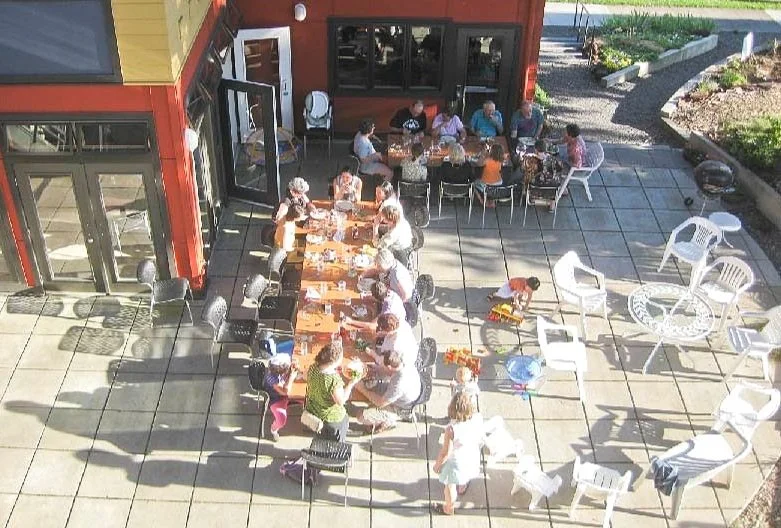
Daybreak is an intergenerational cohousing development of 30 homes in Portland, OR. Construction was completed in late 2009. The 1, 2, and 3-bedroom homes are fully independent, but they also share 7,000 sf of the common area (called the Common House) that includes a commercial kitchen, large dining room, children’s playroom, library, laundry facilities, workshop, indoor bike parking for 90 bikes, 2 guest rooms, yoga studio, and craft room.  From the window of each kitchen,n residents have direct sight lines to this Common House.  All the homes are connected to one another via an exterior walkway that allows the life of the community to be seen and experienced daily.  The walkway also serves as sun shading for the south-facing windows.

A description of the project as well as photos and a video can be found at http://www.aarp.org/home-garden/livable-communities/info-12-2010/lca_portland_1.html

It is notable that 2 of the 5 awards were granted to cohousing projects.  I wonder if this is a tipping point for cohousing - will it truly inform a new paradigm for the American Dream?  One that is not defined by the single-family house with a 2-car garage and white picket fence, but instead a dream that depicts seniors and kids working in community gardens, unrelated adults preparing a community meal, or helping one another with errands in a physical setting that reinforces community interactions and shared resources...all the while enabling residents to maintain the privacy of their individual homes.  Now that's an American Dream that I could aspire to!  (And I know there are still a few homes available for sale if it appeals to you as well!)

Thanks to our design team (noted in a previous blog post about Daybreak, but bears repeating)!  Swenson Say Faget Structural Engineers, Lando Associates Landscape Architects, MGH Civil Engineers, Urbsworks, Maria Cahill, Melissa Medeiros, and Liz Fekete!  And to our most excellent General Contractor - Gabe Genauer of B&G Builders.

related articles:

http://blog.seattlepi.com/boomerconsumer/archives/235746.asp?from=blog_last3

http://www.lakestevensjournal.com/county-state/article.exm/2011-01-19_cohousing__best_of_both_worlds_for_wa_boomers_

http://seniorhousingnews.com/2011/01/17/aarp-and-nahb-announce-2010-livable-communities-awards-winners/?utm_source=feedburner&utm_medium=feed&utm_campaign=Feed%3A+SeniorHousingDaily+%28Senior+Housing+News%29#

http://www.publicnewsservice.org/index.php?/content/article/17945-1

http://www.kugn.com/newsstory.php?id=1617&type=localnews

(We know that an interview was aired on a number of Oregon and Washington radio stations, but if you find more links for news articles, please let us know!)

Saint Mark's Cathedral: Spectacularly Incomplete

The history of architecture is enriched by buildings that are either incomplete, or, if completed, are monuments to plans gone awry. If it were straight, few would have heard of Pisa’s famous bell tower, despite its being the campanile to an adjacent duomo and baptistery both of which are outstanding examples of Italian architecture. The bell tower’s lean is a result of its being built on an inadequate foundation resting on soils incapable of supporting the tower’s tremendous weight. Part of the tower’s charm is that its builders attempted to correct its lean during construction, resulting in its top being kinked compared to its lower levels. So famous is its lean, it is a Unesco World Heritage site and tremendous intellectual and financial resources have been invested to preserve its construction flaw. [caption id="attachment_873" align="alignnone" width="555" caption="The Leaning Tower of Pisa (Image: Alkarex Malinäger)"][/caption]

The tower, or course, was a completed structure. Incomplete structures provide another chapter in the what “might have been” in the history of architecture and engineering. New York City’s George Washington Bridge, on the northern end of Manhattan and crossing the Hudson River (the only bridge to do such a crossing) is an example of a structure whose charms and grace result from its incompletion. Built during the Great Depression, the bridge was designed to be of similar appearance to its famous neighbor to the southeast -- the Brooklyn Bridge -- with the GW’s steel structure intended to be clad in stone. The financial crash of the 1930’s prevented this, and it stands to this day in unadorned magnificence. Le Corbusier, after his only visit to New York City, commented that the George Washington Bridge was: “ . . . the most beautiful bridge in the world. Made of cables and steel beams, it gleams in the sky like a reversed arch. It is blessed. It is the only seat of grace in the disordered city.” Although I disagree with the later, I certainly agree with his initial assessment, the bridge is beautiful in its unfinished state.

[caption id="attachment_874" align="alignnone" width="700" caption="George Washington Bridge, New York"][/caption]

Here on Capitol Hill, we have at  least two incomplete buildings whose final appearance was unanticipated from their designer’s original intentions. Although certainly not of the notoriety of the two above examples, both have, I would argue, greater beauty because of their incompleteness, and are among Seattle's finest structures. A future post shall examine St Joseph’s Catholic Church; today, we shall have a peak at the grand interior of St Mark’s Episcopal Cathedral.

[caption id="attachment_875" align="alignnone" width="700" caption="St Mark's Cathedral Interior"][/caption]

Saint Mark's Episcopal Cathedral is located on 1245 1oth Avenue East, and when viewed from either Queen Anne or Lake Union is one Capitol Hill's most visually prominent buildings. Its construction began in 1928, but due to the Great Depression funds were unavailable to complete it as originally designed, a design that included ornate, granite-clad  Gothic towers and a lush stone and wood interior (see: http://www.saintmarks.org/About/History.php for greater detail).  What one sees today from both the exterior and interior is a cast-in-place concrete structure, only partially finished in stone, brick, and wood. Although St Mark's exterior appearance is somewhat awkward, the interior evokes a magnificence and mystery that alludes to a time prior to its original Gothic precedents, perhaps to an ancient, Byzantine or Romanesque basilica, precursors to the Gothic.

The Cathedral is organized about a large cubic volume. Sub-dividing this space are four massive, concrete columns that not only hold up a great wooden roof, but were most likely intended to support the un-built Gothic tower. The columns must be the largest in Seattle, and have a faceting that gracefully sculpt the daylight entering the space. Facing each other from opposite ends are an impressive organ and a stunning rose window/altar structure. The organ's wood echoes that of the great ceiling, while the aesthetic of the steel and glass rose window complete the atmosphere of the unfinished worship space.

The organ forms the portal through which one enters the main worship space, and is accessible via a set of stairs from the Cathedral's lobby. It provides an excellent prospect from which to see the interior.

[caption id="attachment_878" align="alignnone" width="700" caption="The Wood Ceiling"][/caption]

The Cathedral ceiling is an expressive wood beam and joist construction, suggestive of Bernard Maybeck's Christian Science Church, in Berkley California (St Marks' architects were also from the Bay Area). Its rough-hewn appearance and gently water stained appearance harmoniously match that of the adjacent, exposed concrete (and water stained) walls.

[caption id="attachment_880" align="alignnone" width="700" caption="The Organist"][/caption]

During my Visit to St Mark's, I was entreated to hearing the Cathedral's organist at practice -- the voluminous  space with its hard surfaces provided the perfect resonating chamber for this impressive instrument.

[caption id="attachment_884" align="alignnone" width="700" caption="The Rose Window/Altar"][/caption]

I began photographing around 3:00 pm New Year's Eve, with the low, winter sun piercing the Cathedral's windows.When I was finished a few hours later, I had the good fortune to witness the transformance of the space from one illuminated with the winter sun's fleeting spectrum, to one provided by a stunning lighting design.

[caption id="attachment_885" align="alignnone" width="700" caption="Rose Window and Water"][/caption]

Open to the public, I encourage all to visit this grand building.

2010 in review

The stats helper monkeys at WordPress.com mulled over how this blog did in 2010, and here's a high level summary of its overall blog health:

Healthy blog!

The Blog-Health-o-Meter™ reads Fresher than ever.

Crunchy numbers

Featured image

A Boeing 747-400 passenger jet can hold 416 passengers. This blog was viewed about 3,100 times in 2010. That's about 7 full 747s.

In 2010, there were 54 new posts, not bad for the first year! There were 244 pictures uploaded, taking up a total of 792mb. That's about 5 pictures per week.

The busiest day of the year was November 3rd with 75 views. The most popular post that day was National Parking Day Capitol Hill.

Where did they come from?

The top referring sites in 2010 were schemataworkshop.com, twitter.com, capitolhillseattle.com, facebook.com, and linkedin.com.

Some visitors came searching, mostly for melrose market, montreal library, bakhita gardens, golconde pondicherry, and montreal waterfront.

Attractions in 2010

These are the posts and pages that got the most views in 2010.

1

National Parking Day Capitol HillSeptember 2010

2

Golconde Dormitory in Pondicherry, IndiaSeptember 2010

1 comment

3

Montreal's Grand BibliothequeAugust 2010

1 comment

4

Volunteer Park CafeSeptember 2010

7 comments

5

Capitol Hill's first TOD project - open 6 years in advance of Broadway StationJuly 2010

2 comments