Capitol Hill's Pike-Pine corridor is our neighborhood's greatest urban asset and home to some of our best buildings. Odd Fellow's Hall, Agnes Lofts, and the Elysian Brewing building are just a few of the notables. In addition to these larger buildings, there is (at least) one real gem of a building, but easily missed due to its diminutive size and modest appearance. Don't let its size fool you, for this small edifice possesses a singular quality that makes it a giant amongst its larger peers -- an incredibly handsome and well-preserved wood storefront, remarkable both in its delicacy and in that it unpainted wood-- a bold approach given our 8 - 9 months of rather damp weather (paint is tougher than sealer). Fitting cozily between two recent and boldly modern buildings, 1115 E. Pike does not give an inch to its new block-mates. In fact, the two contemporaries framing it heighten the building’s light touch and historic qualities.
Former tenants for the building include the Seattle Academy of Arts and Sciences, who used it as their music and activities building, after which it was the Capitol Hill LGBT center. Originally, it was an automotive parts building. It is owned by Anne Michelson, who built the condominiums next door (to the west) and also owns Crescent Down Works (http://www.crescentdownworks.com/), whose offices are inside, and whose fine down garments are made just around the corner at 1423 10th Avenue.
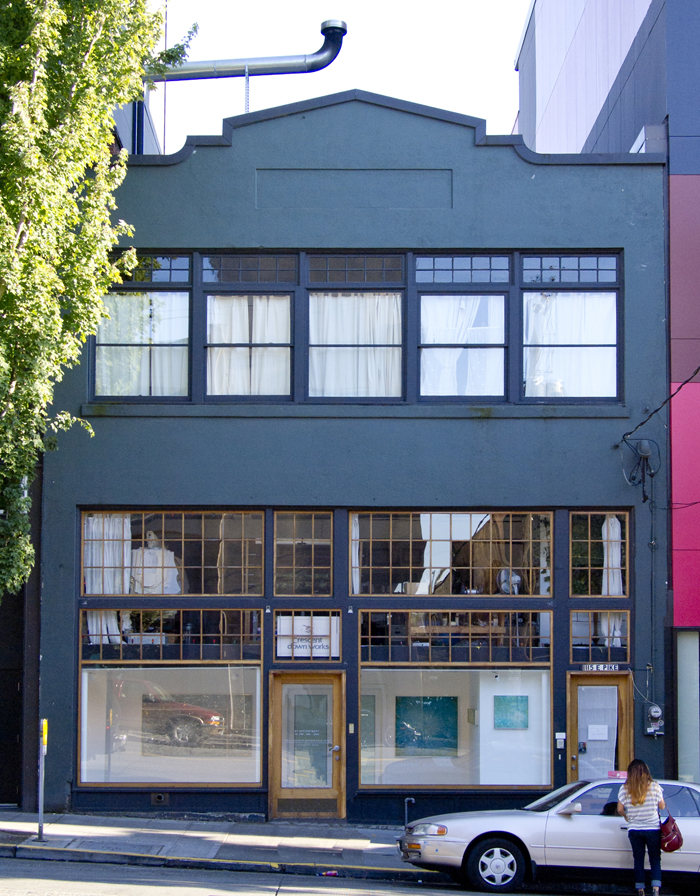
Unlike today's storefront window systems, which are almost exclusively made of aluminum (and of much greater heft), those on many of our heritage buildings are made from wood -- most likely Douglas Fir -- our region's most popular species for both rough carpentry (structural use) and fine wood working (furniture). And though I cannot be certain this is Doug-Fir, the storefront does combine both of its favored attributes, for here we have mullions (which are structural) as finely crafted as if they were ornamental woodworking (furniture). This level of handcrafted quality was typical before mass-produced steel and then aluminum storefronts came to the forefront. Not encrusted with decades of paint or the often multitude of replacements parts, the storefront on 1115 is remarkably intact and in stunning shape, radiating a pleasing golden glow.

Examining the two photos above, one can see that this storefront was built on-site. Despite the (dare I say) machine-like precision of the smaller mullions, the large wood framing members (in blue) have an irregular pattern, indicative of the different trades involved in the storefront's erection (rough framing verses fine woodworking). The photo above shows how the window maker cheated the left transom mullions to be a bit smaller than those in the field to the right, in order to account for the relative imprecision of the larger structural framing. This does not detract from the facade's overall presentation; however, it may actually enhance it by nicely juxtaposing the precision of the window mullions and their clear finish, with that of the large framing members and their dark, ink-blue paint.
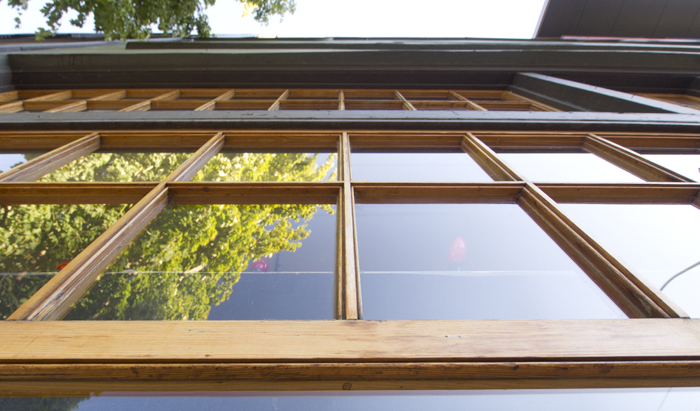
This photo reveals how the window itself is framed. Even though constructed on a par with fine woodworking techniques, its structural role is an important driver in its final form. The part of the mullions furthest from the face of the pane of the glass is the primary structure; the slimmer profiled piece that is closer to the glass is what is holding the glass in place. Though separate, each contributes to the overall integrity of the assembly. The differing sizes relay this hierarchical deployment, as well as adding nice shadow lines and detail to the whole. This is ultimately, the way it should be, isn't it? -- Beauty derived from a clear and recognizable hierarchy of parts to the whole, with no artificial ingredients needed. A discerning eye may also notice one real advantage our heritage storefronts have over those of today – no insulating glass! Like countless other, older Hill buildings, the glass in this assemble is ¼” thick single pane glass. Today’s high performance systems are an assemblage of two ¼” panes, separated by ½” of air, all contributing to a much more energy efficient product. Modern energy codes are a good and necessary thing, and well worth the efforts, but the aesthetic results are of secondary concern.