
The design of infrastructure – public works – in the United States is lacking the civic qualities one finds in other countries, notably those in Europe. A contributing factor to the differing continental approaches in design can be understood as the differing rules of decorum between the state and the populace (in Europe a heritage of monarchy, while in the United States a heritage of limited government). These two opposing traditions translate into the built environment; in the case of Europe an acceptance of the former to visibly display its prowess and acumen to the later, while in the United States grandeur in public works is associated with government that has exceeded its mandate. And though Europe is now composed of democracies, their heritage lends itself to an artistic license that is essentially absent in the United States.
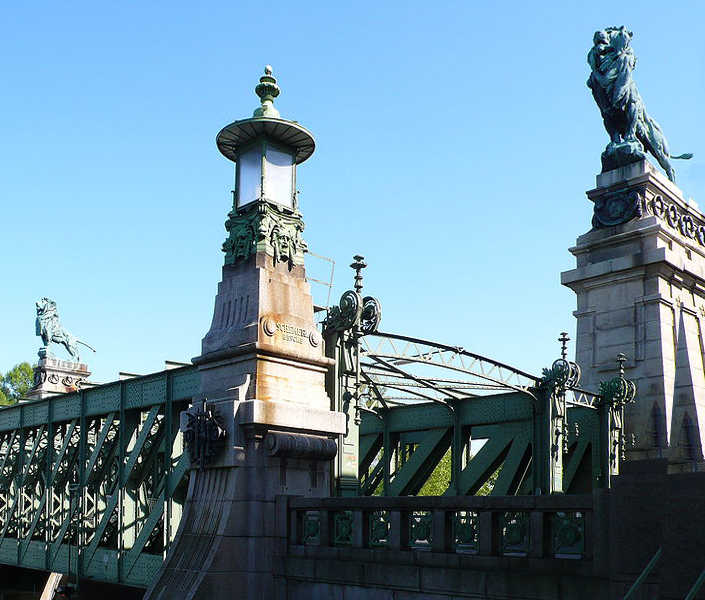
Otto Wagner’s impressive Nußdorf Weir and Lock (a flood control project on the Danube River, in Vienna), is a classic example of royal patronage of the civic architecture. Wagner was Austria’s leading architect in the late 19th and early 20th Centuries, and typical of that era and place such talent was sought after by the country’s rulers to not only design a functional public work, but to also create one that reflected the ruler’s superior tastes and command of public resources. While the United States may lack the royal patronage that fostered such impressive structures, Seattle is fortunate to have a noteworthy collection of well-designed public works that are not only pleasing to the eye, but also prompt exploration by the public who funded it. The Hiram M. Chittenden Locks on the Lake Washington Ship Canal, with their associated public gardens, concrete gate houses and promenade, and fish viewing platforms are a Seattle favorite, and in some ways like the Nußdorf Weir and Lock (minus the lions, of course) in that they are both water works. Here on the Hill, we are fortunate to have the Volunteer Park Water Tower, another water related piece of infrastructure.
The water tower, built by the no longer extant Seattle Water Department in 1906, stands 75 feet 6 inches above the adjacent road (Capitol Hill's highest point), about the equivalent of a six to seven story building, thus making the top of the tower 520 feet; or, a couple of hundred feet shy of the Space Needle. One could actually say there are two towers in Volunteer Park, the brick outer tower and the steel-plate inner tower where the real business occurs. Seattle Public Utilities is now the steward of the water tower(s), which is adjacent a reservoir, another attractive piece of city infrastructure. The tower plays a vital role in our drinking water supply, as it provides pressure for the water pipes serving the needs of our Capitol Hill Community, some extra storage capacity, and doubtless some other functions as well.
[caption id="attachment_2897" align="alignnone" width="700" caption="Tower from the South East"]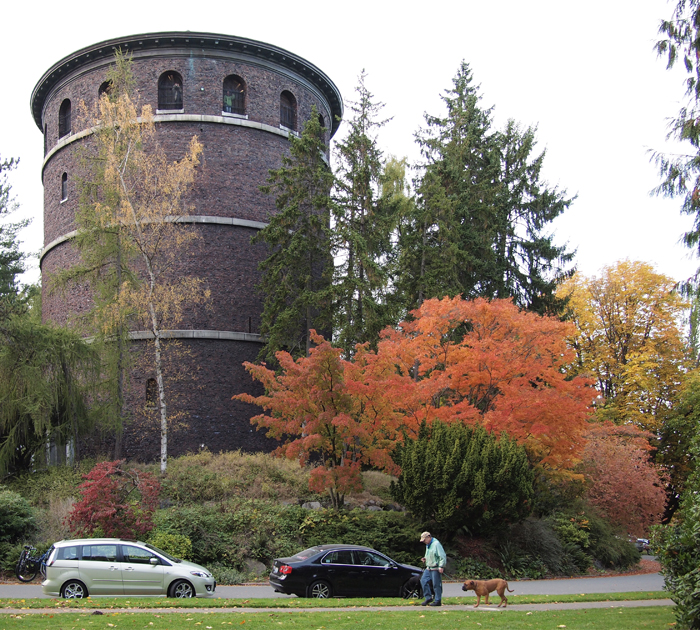 [/caption]
All well and good it is to store our water, but the ‘civic-ness(?)’ of the tower lies in the fact that it performs the above functions while simultaneously being great piece of public architecture, much in the same way as the Wagner and Chittenden Locks do, but in its own Capitol way and in a manner that fully exploits its advantageous location. The first hints of these beyond utility aspirations are in evidence in the pair of matching entries (on the north and south of the tower): each with its own proud, pedimented entry. And each made of that most robust and permanent of materials -- granite. And the text on the frieze -- Aqua Pura MCMVI – directly references to those ancient builders of the world’s most enduring water works, the great aqueducts of the Roman Empire. A bit haughty perhaps, but certainly appropriate.
[caption id="attachment_2895" align="alignnone" width="703" caption="North Entry"]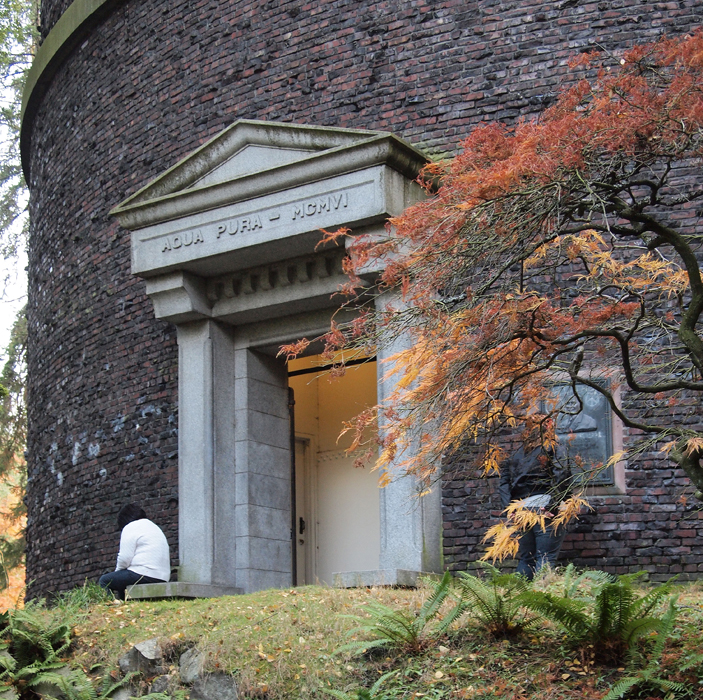 [/caption]
Another material flourish that raises the tower above mere utility is the clinker brick cladding. Clinker brick is a brick that has been fired at such a high temperature that it forms a glaze on its surface, and is often deformed in the process. Denser and stronger than typical brick, clinkers are typically used only as architectural accents in a larger field of simpler brick (they are a trademark of Capitol Hill’s Anhalt’s); however, the designer of the tower felt that the robust and rough appearance of the brick was appropriate to the underlying utility of the entire edifice, thus conveying a sense of age, while simultaneously of permanence. The shadow resulting from the deformed profiles of the clinkers, along with their stunningly rich and complex earth tones, help to dematerializes the structure; which, despite its height, fits in perfectly with Volunteer Park’s Olmstedian landscape. As an unintended bonus, their deformed profile lends them a convenient surface to grasp and rest one’s foot, a quality not lost to many a neighborhood rock-jock.
[caption id="attachment_2898" align="alignnone" width="652" caption="Clinker Brick"]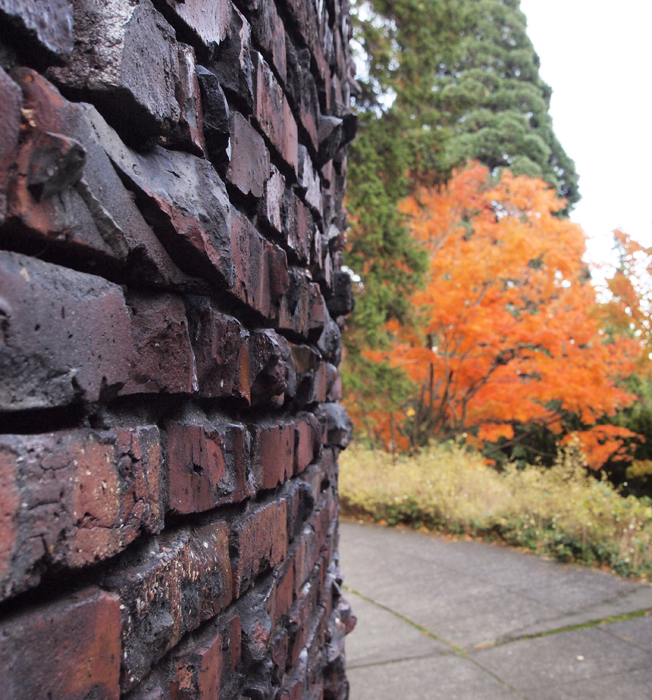 [/caption]
[caption id="attachment_2896" align="alignnone" width="513" caption="Climber"]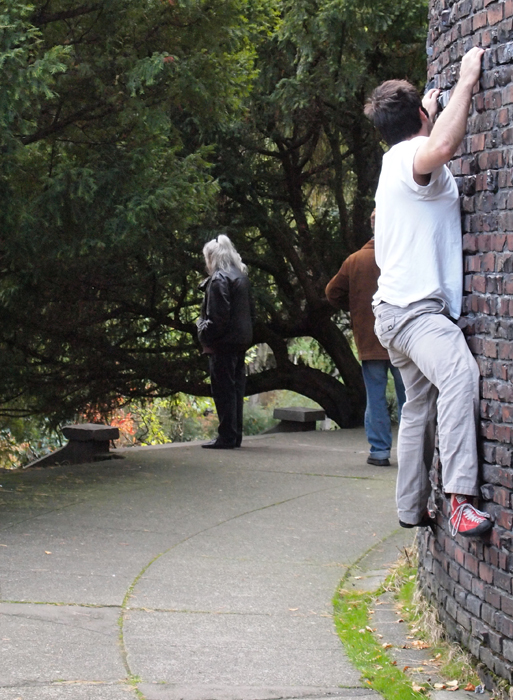 [/caption]
One-hundred-and-six (or is it seven?). That is the number of steps one must climb to reach the viewing deck – the great prize that Seattle Water Department gifted to us in the planning of the Tower. The steel steps emit a hollow-ringing sound as one ascends, reverberating throughout the serpentine stairwell -- a nice warning that others are approaching. There is a pair of stairs, one for reach entry, which spiral around the water tank, double helix style. Once inside the stairwell, one can see the inner, steel tower, as the water contained within presents far too great a structural load for the brick to handle. The steel plates are riveted together as was common for steel fabrications of the period. I am not sure of the thickness of the plates, but I am sure it is measured in inches, not fractions thereof. And just look at those rivets, there must be thousands of them! And although I cannot be sure of this either, the tower assembly rests upon a mound, in an effort to conceal as well an enormous foundation, as well as related plumbing gear.
[caption id="attachment_2902" align="alignnone" width="525" caption="Stairs"]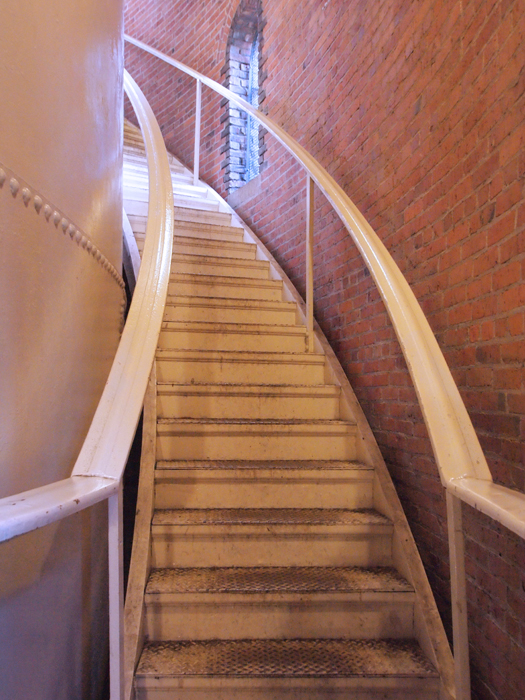 [/caption]
[caption id="attachment_2901" align="alignnone" width="588" caption="Rivets"]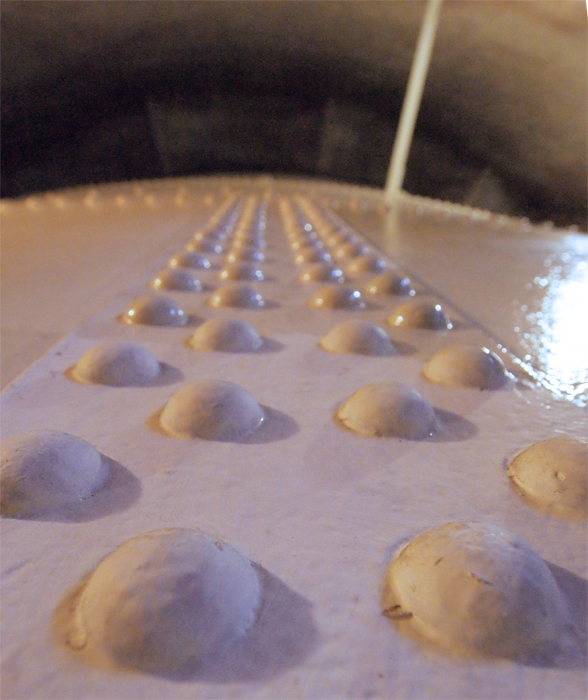 [/caption]
Once at the top, there is a real surprise for first time visitors and a justification to regulars who slog up the steps. Historic plaques, comfortable benches, and a generous number of large windows make the viewing platform a popular destination and pleasant place to rest, gaze out over the landscape, and learn some local history. The tectonic lessons are not over either, as the great steel tank does more than hold millions of gallons of water. It also helps to hold up the roof, or is it the other way around? In either case, there is some structural interaction between the two, as the mid-point of the trusses spanning the view platform has a pair of rods going down to the tank. I think the rods may actually brace the trusses that in turn brace the top of the brick wall, keeping the latter form falling over, in the same manner the rods that join the steel tower to the brick tower in the stairwells. But that is just a guess. The trusses themselves provide an opportunity see uncommon, radial framing.
[caption id="attachment_2903" align="alignnone" width="700" caption="Interior"]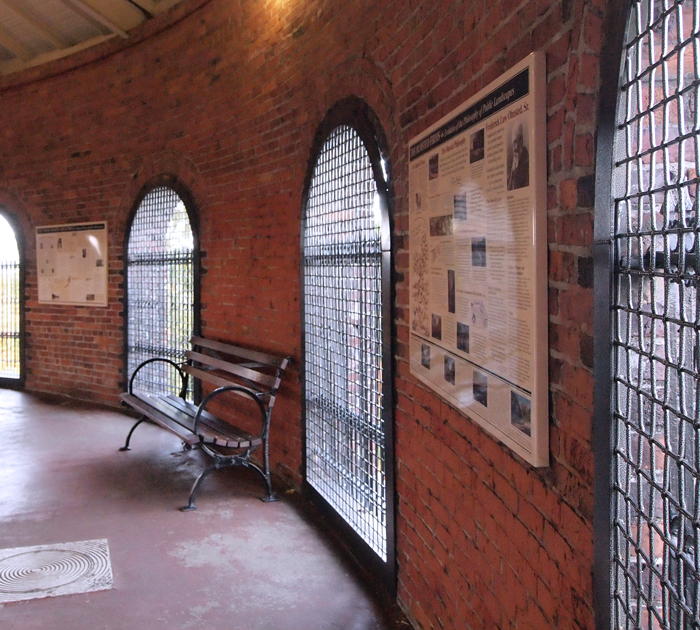 [/caption]
text
[caption id="attachment_2899" align="alignnone" width="700" caption="Roof Truss"]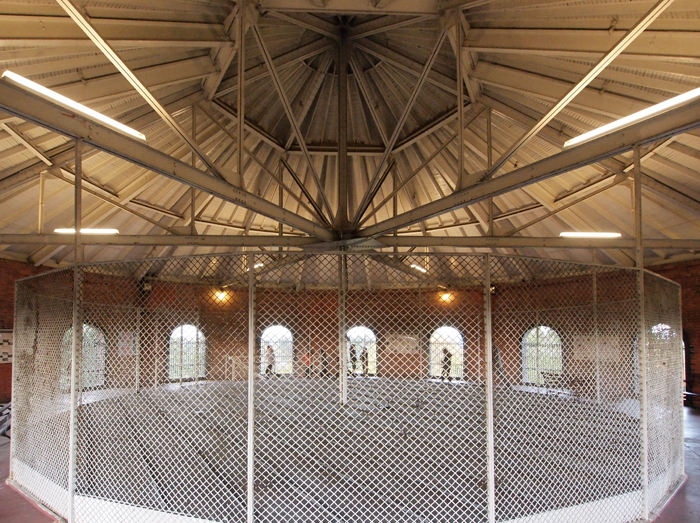 [/caption]
Yet even an enthusiast for architecture and civic design must confess that all the above is mere hyperbole, compared to the tremendous 360-degree view one gets of our gorgeous city.
[caption id="attachment_2900" align="alignnone" width="700" caption="View"]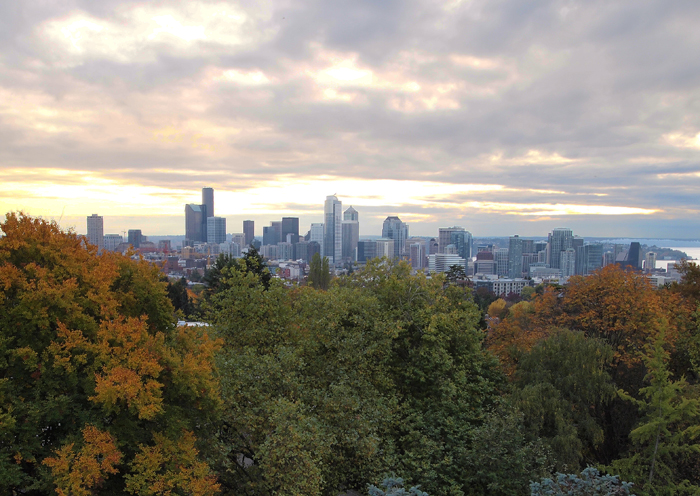 [/caption]



 [/caption]