Skyway Community Vision

The Skyway community, organized through Skyway Solutions, has been investigating ways to invigorate itself. A series of workshops in 2009 resulted in a community agenda that outlined ways to revitalize the city. The idea of a community center arose in concert with other ideas that emerged during that process. The community is looking for a place to engage with their neighbors, learn new skills, teach others, share resources and gather to dance, cook, exercise, read, and celebrate. The spaces will be flexible, and will change throughout the day; the community center will be a place for all ages, a living room for an extended family, a gathering place at the center of the community that will be full of life - the community’s social hub.

Schemata Workshop's role has been to develop a conceptual plan and perspective image that grasps the community's vision. Through three workshops we have been able to gather some exciting ideas about how the community center should be organized by collaborating with the people of the Skyway neighborhood.

Workshop #1

The purpose of this workshop was for Schemata Workshop to learn what kinds of activities the community envisions taking place in a community center and to understand the community's prioritization of the spaces provided to us to incorporate in the overall floor plan. 

ss_workshop1_1.JPG
ss_workshop1_2.JPG


Workshop #2


This second workshop’s intent was to encourage and assist the community to visualize how their building should be organized and used. Which spaces should be located next to each other? Away from each other? Can some spaces be used for overlapping functions? What other issues arise when the building starts to take shape? How much security versus openness?

Part of the intent of this activity was to provide the community with a tool for thinking about how building spaces could respond to what uses they need, rather than start with a given building and make the program fit the building. Why? Either approach requires an enormous investment of time, effort and finances, but the first approach helps ensure that the building provides what is actually needed and will be used.

ss_workshop2_1.JPG
ss_workshop2_2.JPG


Workshop #3

After the second workshop Schemata Workshop took the three plans developed by the community members and developed five schematic floor plans and presented them at the final workshop. Community members were asked to provide positive and critical feedback about all of the layouts. They were given 6 lime-colored post-it notes for positive comments and 6 purple post-its for critical comments. The purpose of the exercise was not to select a “winning” layout, but rather to get a clearer idea of what features people like or don’t like. For example, looking at the comments, participants like an open reception lobby, angled spaces to add variety, doors and movable walls that allow rooms to change in size, a covered entry porch, locating the kitchen away from the gym, and providing a skate park, among other things. There is a strong desire to have a swimming pool, but the community also recognizes the cost implications, both upfront and for long-term maintenance. All of this feedback was used to generate a final conceptual perspective and floor plan that was presented at a potluck held for members of the community to gather and celebrate the hard work and efforts put into driving this community vision. 

ss_3.jpg
ss_4.jpg


A potluck was held to present the conceptual images to the community and for everyone to gather and share their delectable family recipes. I got to participate in Skyway Jeopardy with little success in naming streets and businesses. Overall the event was a success with at least fifty people in attendance. 

It has been very rewarding for me to be able to work with the people of Skyway and see their enthusiasm to push for a much-deserved community center especially since the community reminds me of the town I grew up in. This project has also just given me a great opportunity to break out my brushes and watercolors. 

ss_potluck_2.JPG
ss_potluck_3.jpg

Schemata Holday Party 2013

Thanks to all who attended our annual holiday party, which not only celebrates the season, but also the anniversary of the founding of the practice in 2004. A highlight of the evening was the presentation by Ali Davidson of the Woman's Funding Alliance (http://www.wfalliance.org/), and the many efforts in support of our state's woman and girls this fine organization undertakes. The other highlight, of course, was the chance to share good times with friends, consultants, and the many great clients that have help 2013 be our best year ever. It was also a great opportunity to meet the spouses and partners  of our new staff.

Best wishes to all for 2014!

womens funding alliance.jpg
audience for presentation.jpg
Young Lady Applauding.jpg
ella and friend.jpg
greenlaw.jpg
Ashley Photo.jpg
joel and christine.jpg

Schemata Open House + Party

If you haven't heard we are having a party in celebration of our wonderful collaborators and friends. We hope you will join us! 

Be one of the first 25 people at the party and get a free Schemata t-shirt.  

This year, we are proud to highlight the Women’s Funding Alliance and the great work they do for women and children across Washington State. They will give a very brief presentation between 5-5:30.  Join early to learn about WFS. Be one of the first 25 people and you get a Schemata t-shirt. 

If you are an MWBE firm, we invite you to come early (4pm) to learn more about our firm and network with our staff and the other firms before the festivities get fully underway.

We would appreciate your RSVP so we have enough for you to nibble and imbibe.

Schemata Workshop Holiday Party + Open House

1720 12th avenue, Seattle WA
December 6, 2013 
5-8pm

Marking Time at Bertschi School

Bertschi School is a private K – Fifth grade school on 10th Avenue, on the northern slopes of Capitol Hill. Founded in 1975, and steadily growing to its current enrollment of about 235 students, its measured and incremental growth on the Hill is a fascinating example of both architecture’s and landscape’s marking of time as well as the fulfillment of the vision of the school’s founder to support high quality and progressive design.


10th Ave View small.JPG
Converted House small.JPG

Located in a primarily single-family home stretch of 10th that has an occasional smattering of apartment and commercial structures, Bertschi’s campus is an engaging combination of converted bungalow homes, a church, Seattle’s first Living Building and a gymnasium by one of Seattle’s most celebrated architecture practices. While such a mosaic of buildings and periods could lead to an awkward ensemble, in Bertschi’s case the seeming tapestry of original uses, periods of construction, and changes in topography are held together quite well by both good stewardship, thoughtful planning, and intriguing juxtapositions of building and landscape.

Brigitte Bertschi, to whom I was briefly introduced to the day of my tour, is of Swiss heritage; a country of outstanding architecture practices and a stunning natural environment. I cannot help but to think her Swiss-ness shaped her sensitivity to place, environment, order, and aesthetics, as is in evidence at the school she runs.

Play Areas Looking North small.jpg
Stepped Seating small.JPG
End of Play Area small.jpg

The majority of the campus buildings are comprised of re-purposed single family homes and provide space for a variety of uses, including: administration, facilities, academic, and the school’s former gymnasium. Despite these myriad of new uses, the homes still maintain much of their original charm and appearance. Also changed is the manner in which the formerly discrete and private homes and their yards now interrelate in an all-encompassing landscape; their former isolation now blended into a most delightful recreation and learning environment for the students. The stepping of the landscape -- a heritage of both the prior private uses and need to follow the dropping topography -- creates a series of smaller play areas and interesting vantage points from both high and low ground alike; a variety of terrain that must prompt exploration and play by the students.

In Between Space small.JPG

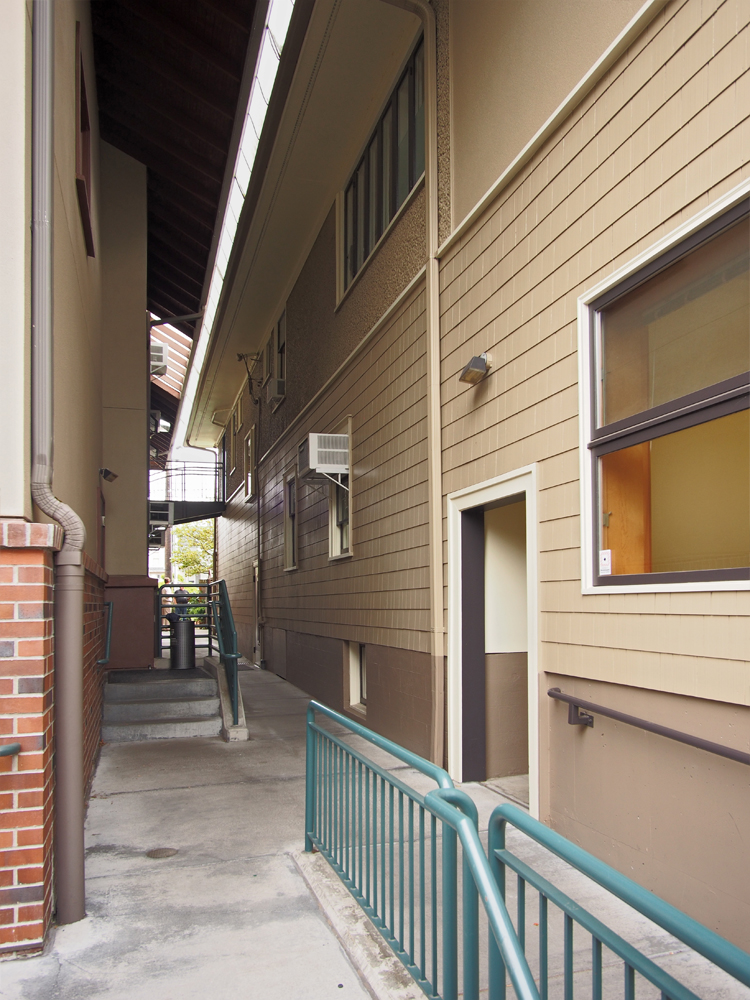
These landscapes, following the landscape’s stepping and no longer in need of fences for privacy, are now joined by a series of cozy, in-between spaces nestled between buildings. The spaces form a nice counterpoint as well as a reminder of what has been. The school has had to make the best of what the confined campus they have had to use, leading to spaces appropriately scaled to the student population’s diminutive size. The layering of a crisply defined and varied topography, intimate, alley-like spaces, and variety of building styles lends the campus a pleasing urban character.

PV from Above small.jpg
Cisterns and House 1 small.jpg

In both its landscape and its buildings, the school’s emphasis on environmental stewardship reveals itself. Solar panels are arrayed on the older buildings, while newer structures, the gym and science buildings, have obtained significant sustainable building distinctions. The gym, designed by Miller|Hull, has an abundance of daylight uncommon to this typology and is a LEED Gold structure.

The parking garage it is over is covered in part by the gym, as well as a playfield – a nice use over such a structure, and a clever way to create usable space. Further anchoring the gym to the landscape is a breezeway that contains solar panels as well as a rain water harvesting system and a green roof. The system terminates in an artful ensemble of galvanized cisterns.

Gym Exterior small.jpg

The Science Wing is the state’s first Living Building, currently the highest recognition for sustainable building in the US. Designed by KMD Architects, the building has many energy saving and generating strategies, and even provides spaces for urban agriculture. There is also a living green wall that helps with air quality and humidity within the building.

Living Building small.JPG
Green Wall small.JPG

Bertschi School is one of those special Capitol Hill landscapes that is greater than the sum of its parts. Its variety of spaces and character of buildings merits exploration and is highly recommended should you have an opportunity to do so.

Schemata Adds Staff

Things continue to be busy here at SWorks, and we have added staff; two permanent and three contract (whom we hope to keep!). As the point of contact for staffing, I feel very fortunate to have been able to recruit so many strong candidates in a competitive job market.  Regardless of status, all are a great fit for the environment we try to craft in our studio; if you have a chance to meet any of them you will surely agree.

Scott Nye comes to us by way of Scottsdale, where he recently finished his MArch at ASU, and has about 5 years of experience. He is a recent Seattle arrival, and lives in Ballard.


Scott.jpg

Roma Shah is a recent UW MArch/MLArch graduate, and graduated from the University of Florida (my Alma Mater) with an undergraduate in architecture.  She has several years of experience, and has lived in Seattle for six years. Roma lives in Ravenna.

Roma copy.jpg

Jeff Hammerquist hails form Caly Poly San Luis Obispo and was a classmate of Emily Woods (go Mustangs!). Jeff grew up in the Puget Sound region.

Jeff H.jpg

Troy LaCombe just complete his BSArch from the UW. He is from Louisiana (hence the French surname?), and lives on Capitol Hill.

Troy.jpg

Last but not least is Elias Gardner, who is shoring up our east-coast contingent (though we are not sure he is as surly as Jeff Busby or me). He attended Williams undergrad, where he received a BFA, and has a MArch from RISD. He too has several years of experience and recently moved to Seattle and lives in Columbia City.

Eli.jpg
All copy.jpg

The Schemata staff, less Christopher Palms who is on vacation.