Boylston Court

Courtyard housing is one of the oldest types of housing — whether for individual or multiple families — and dates back to at least ancient Greek times. It has such a lengthy heritage for several reasons, including interior cross ventilation and increased access to daylight. Outdoors, there is the ability to achieve a well-defined (and defended) space, which can be completely enclosed or open. Capitol Hill has its own assortment of courtyard housing, the majority most likely built before the 1970s with the Anhalts, dating to the 1920s, as the most famous example. As to the reasons for courtyards falling out of fashion I can only speculate, but maximizing return on investment must be one of them, as providing large planted landscapes not only lessens the number of units per parcel but also increases operational costs. Whatever the reasons, it is unfortunate fewer of them are being built.  

[caption id="attachment_2102" align="aligncenter" width="720" caption="Boylston Court view of Courtyard from Street"]Boylston Court view of Courtyard from Street[/caption]
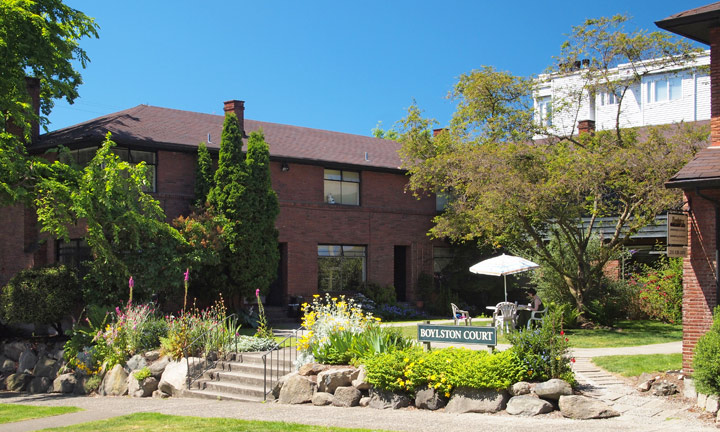
 

I have a couple of favorite courtyard housing projects on the Hill, including Boylston Court, a nicely complex project just west of Seattle Central Community College, and the subject of this posting. Boylston Court has several noteworthy qualities, including a lushly planted and well maintained landscape, a south facing courtyard, and – my favorite aspect — an astonishing variety of design and detail in a compact footprint. Taken individually, the parts of Boylston Court are nothing outstanding; rather, it is in their successful assemblage that an exemplary building is found.


[caption id="attachment_2103" align="aligncenter" width="720" caption="Boylston Court view of Garages Along Olive"]Boylston Court view of Garages Along Olive[/caption]
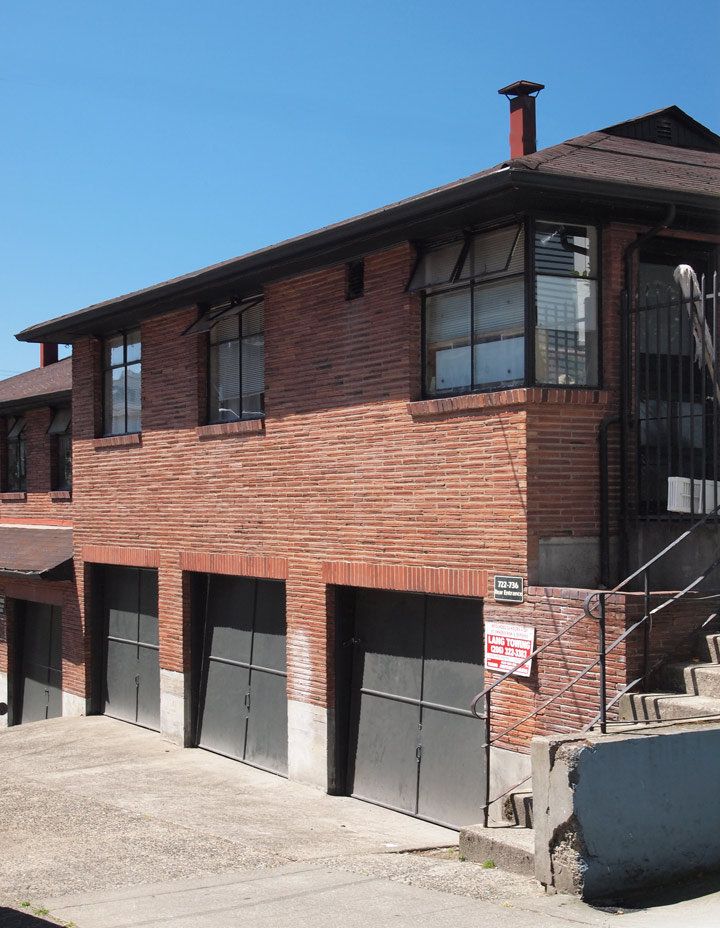
 

Most likely built in the 1950s, it has many elements of that era. including roman brick and steel framed windows. I know I am not alone when I write that I am a sucker for steel-framed corner widows. And who wouldn’t be? They occur in several locations at Boylston Court, at both prominent, and well, less prominent, locations (such as this one at the above garage). But ooh, what beauties they are, regardless of location. It is a shame that steel windows today are (incredibly) expensive, making them prohibitive for most projects — a reason for us to treasure and preserve the few remaining ones we have. Other details include the most minimal of handrails (as seen  in the above photo) — similar to the steel windows there is nothing there but the minimum needed for support. Too bad such delicacy  is not allowed by code anymore . . .


[caption id="attachment_2104" align="aligncenter" width="730" caption="Boylston Court Southwest Corner of Courtyard at Olive"]Boylston Court Southwest Corner of Courtyard at Olive[/caption]
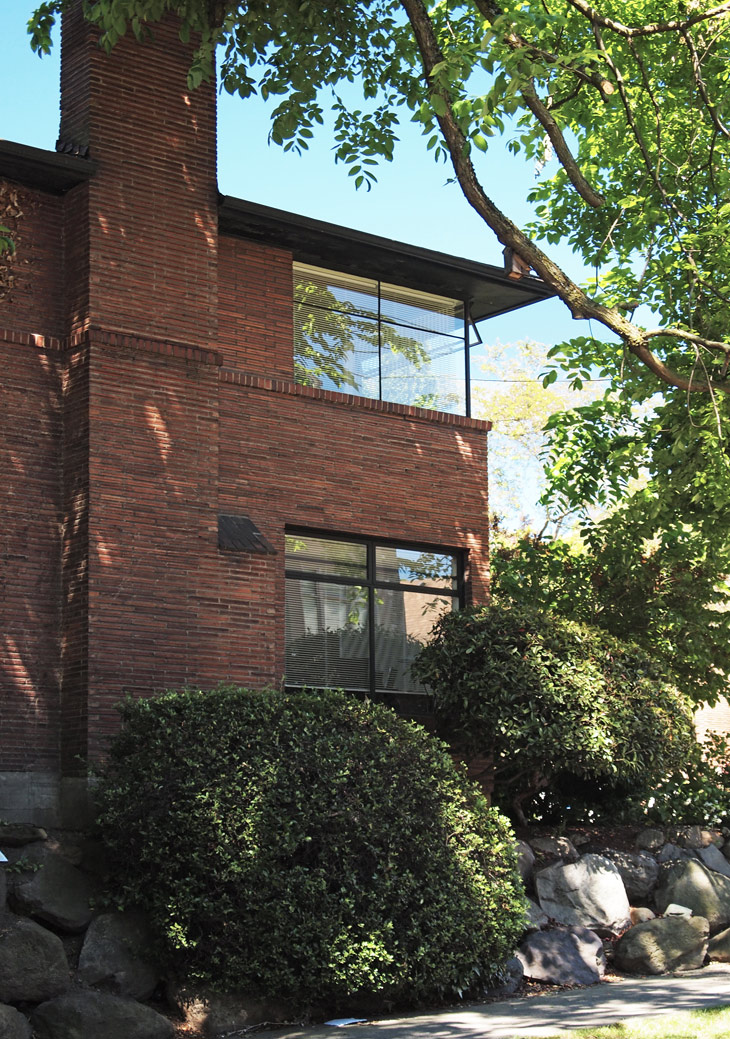
 

Opposite the courtyard from the above garage photo is another beloved steel-framed corner window, this time with the roof seemingly floating above it. I pray the owners never swap them out for vinyl windows (it does happen). Note how the foreground gives a hint of the courtyard landscape contained beyond.


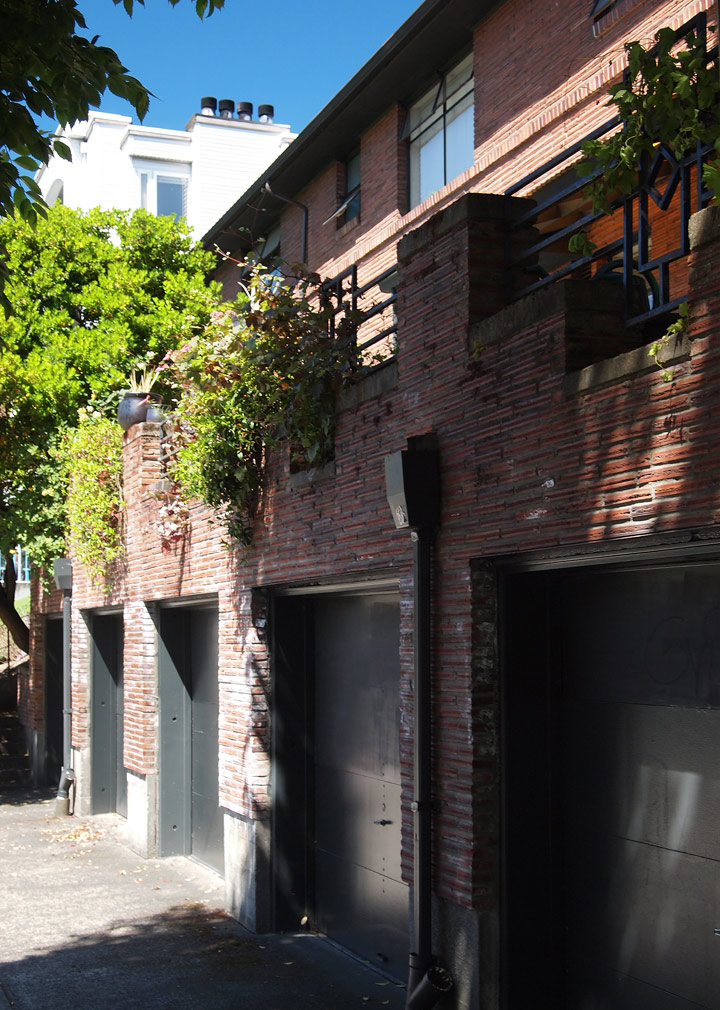
[caption id="attachment_2105" align="aligncenter" width="720" caption="Boylston Court view of Eastern Building from Olive"]Boylston Court view of Eastern Building from Olive[/caption]


Above is an alternate view of the garage facade in the second image. Just beyond Boylston Court is an even older apartment building (in blue). Compared to the box that is its neighbor (and mind you, I do fancy boxes) Boyslton Court’s facade and massing falls with the grade. This not only creates a better pedestrian environment (garage doors not withstanding), but also creates a break in the mass of the building at both the roofline and the plane of the facade. Here is a break down in massing (that Holy Grail of design review boards) that is actually understandable and ties back to something tangible. What a refreshing departure from the current modulation craze that seems to have neither rhyme nor reason, other than a designer’s whimsy.


[caption id="attachment_2106" align="aligncenter" width="720" caption="Garages and Decks along Boylston Avenue"]Garages and Decks along Boylston Avenue[/caption]
[caption id="attachment_2107" align="aligncenter" width="720" caption="Facade Along Boylston with Varandah Above"]Facade Along Boylston with Varandah Above[/caption]
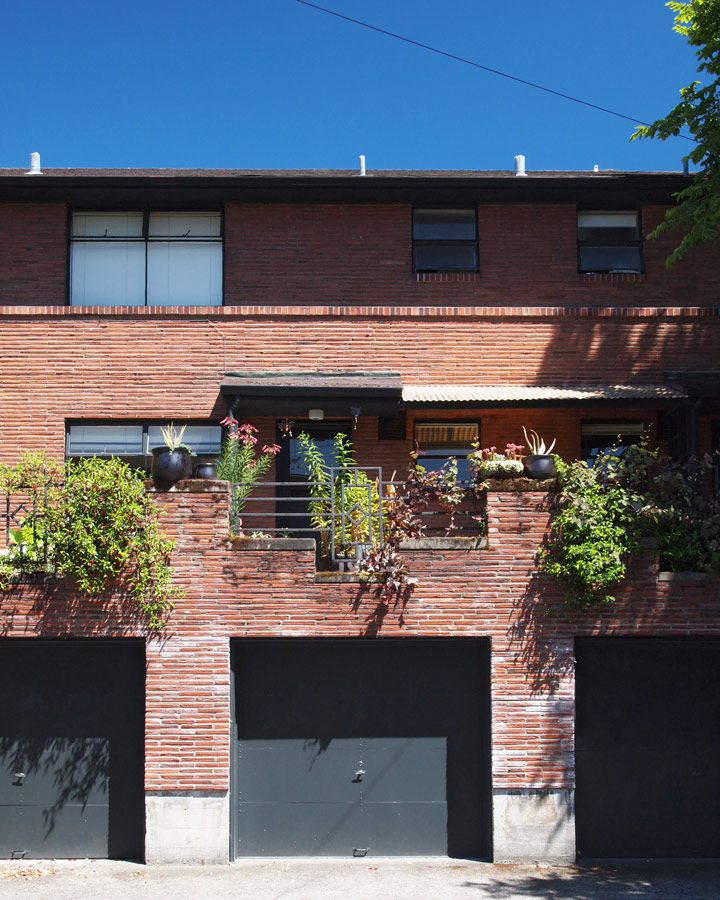
 

The other street elevation of Boylston Court occurs, appropriately enough, along Boylston Avenue, where the designer created one of the better apartment facades on Capitol Hill although it is (again) dominated by garage doors for a section of its length. Despite this apparent handicap (or because of it?), over the garages there is a nice and spacious verandah on the level above the garage, whose size makes it appear to actually be quite usable. Being this close to the street a nice venue is offered for the residents and passing public to informally engage with one another (or not). Here, the garages are effectively used as a base, an intermediary that helps to maintain protocols. The garages also provide modulation (that again is understandable) to the verandahs, and order the various levels of transparency of the facade as it transitions from brick to metal railing and back to brick. Classic.


[caption id="attachment_2108" align="aligncenter" width="720" caption="Boylston Court End Unit with Private Entry"]Boylston Court End Unit with Private Entry[/caption]
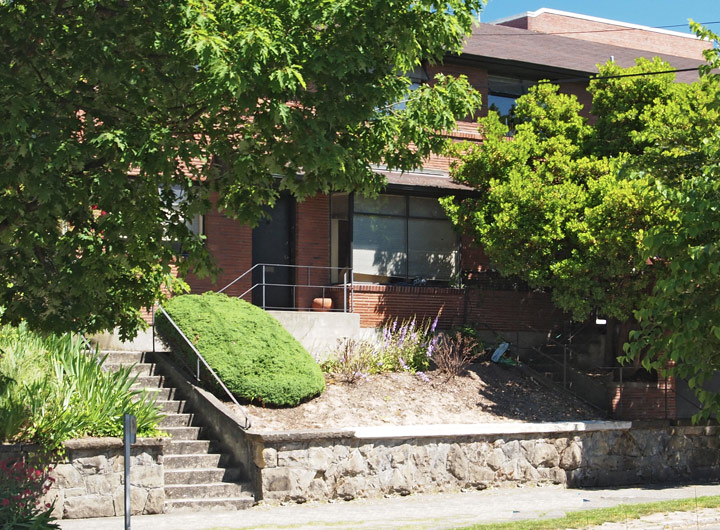
 

Further north along Boylston is still another expression, this time more of a townhouse or even a single family home. Making a return appearance is the delicate guardrail from along Olive and the much-loved corner window. This unit even gets a bit of a front yard and entry porch, in place of a verandah, as well as its own set of stairs. Despite this entry being the fourth (fifth?) design treatment of the street frontage of the modestly sized project, the complex’s over-all architectural unity remains in tact. This is an extremely delicate balance to maintain, especially with so little street frontage. To have all of these parts flow cohesively is not something to take for granted, as each section can simultaneously stand on its own merit while still contributing to the greater whole; however, it is not just the buildings that play a role. The landscape’s design is equally important, be it the built landscape of the verandahs, the micro, intimate front yard noted above, or the the courtyard, pictured below.


[caption id="attachment_2109" align="aligncenter" width="720" caption="Boylston Court Inner Courtyards"]Boylston Court Inner Courtyards[/caption]
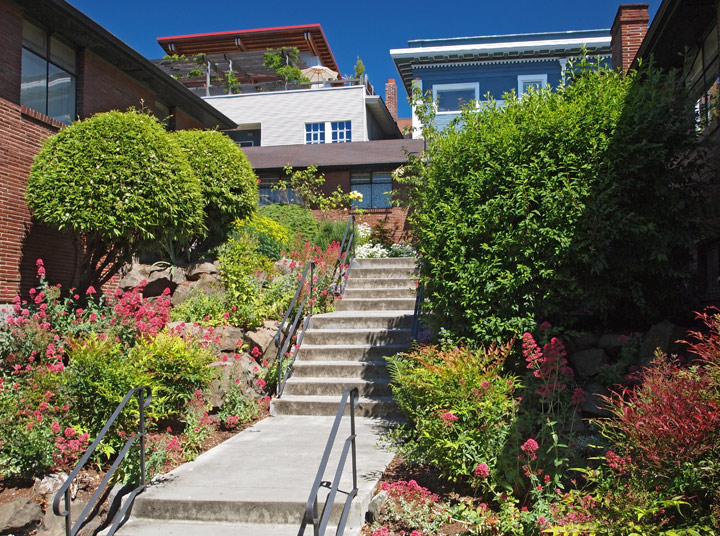
 

Instead of digging a large hole, and filling it with building (a typical approach), the designers of Boylston Court approached the site differently, leading to the above-mentioned qualities.  Where this approach really bears fruit is in the courtyards. In addition to the large, central courtyard depicted above, there are two alley-sized-courtyards that wind their way up the site, to the east and then north, creating a splendid terracing and layering of space effectively creating shared landscapes that are at the same time intimate. A well resolved dichotomy.


[caption id="attachment_2110" align="aligncenter" width="720" caption="Courtyard Facade with Wood Siding"]Courtyard Facade with Wood Siding[/caption]
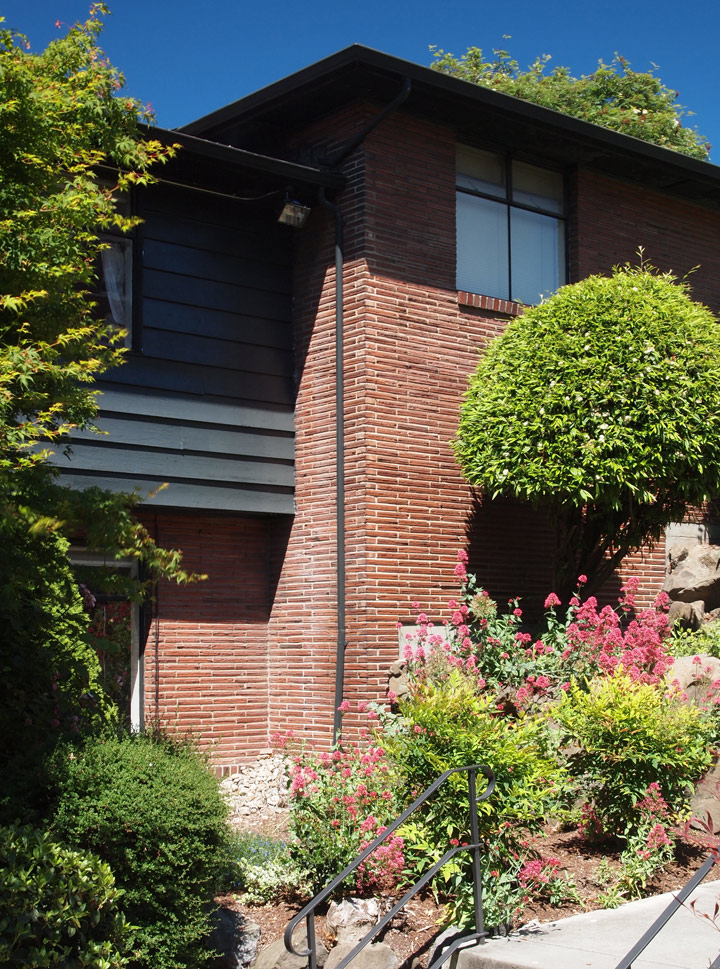
 

Above, one sees the only significant break in the otherwise uniform palette of roman brick — rough sawn cedar siding (a fuller extent can be seen the first photo); curious, that this change is somewhat buried in the courtyard, and not on the street, where it would be more ‘expressive’. Or is it? I like to think it yet another example of the designer’s sophisticated approach. Whisper, don’t scream. Also, the wood siding is a softer material than the brick, and in the designer’s eye more apropos to be within the softer courtyard, the softer landscape.

Boylston Court is a great building in our neighborhood, and a great example of how a context driven design (be that the site or the content of the building’s program) can provide a wealth of valuable clues about which to design, and lead to a building that not only fits well into its context, but enhances and creates its own. It is also a superb example of courtyard housing, and a building typology I would like to see more of on the Hill (albeit, at a greater density).
A Tale of Two Spaces

Design of successful public landscapes is a difficult endeavor. Despite the use of good materials and beautiful plantings, and careful execution, there is one key component that can only happen (if one is fortunate) until after all other efforts have been completed: the peopling of the outcome.  For unlike buildings, which have a program guaranteeing that they will at least be used — if not loved — by the public, participation in landscapes is largely voluntary, as landscapes do not have as thorough a set of programmatic requirements (if any) as do buildings. ‘Build it and they will come’ may work for buildings, but not for landscapes. Landscapes, therefore, require a conceptual order outside the confines of the landscape itself, one that artfully blends utility, beauty, and cultural/social relevancy  in order to be inviting. Absent that balance, even the lushest landscape would pass underappreciated and underutilized, and therefore largely unsuccessful. Case in point: Seattle Central Community College’s lovely – but largely unsuccessful – garden-plaza landscape at the intersection of Broadway and Pine Streets, the first of the Two Spaces. Despite having several great attributes (as described below) it is a space that is used only part-time, and typically only when SCCC classes are in session. Part-time success is not be bad per se, except that the landscape in question happens to be at one Broadway’s most important crossroads, and one that needs full-time use, full-time activity. Full-time occupancy.  

The Pine and Broadway Entrance

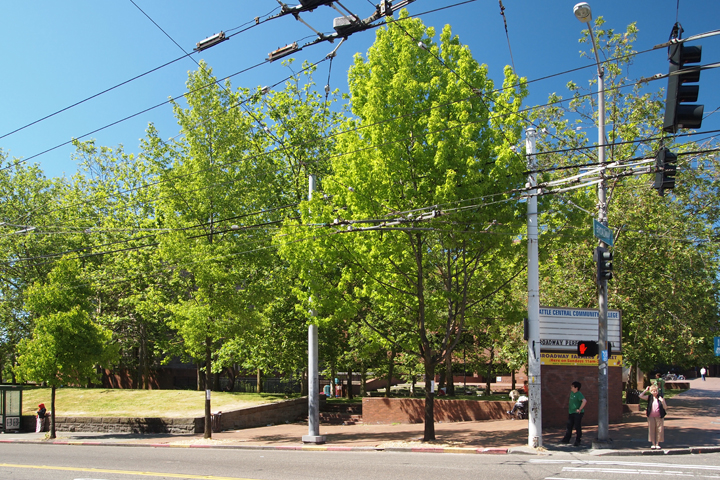
[caption id="attachment_2083" align="aligncenter" width="720" caption="The Pine and Broadway Entrance"][/caption]

As the photos herein depict, the garden-plaza is a surprisingly pleasant landscape, both nicely planted and well sculpted, as well as being a classically modernist design. The London Plane trees (its most immediately recognizable feature) are a traditional favorite throughout North America and Europe, and were specifically bred to achieve urban heartiness — making them a great choice for this location. The visual interest of their exfoliating bark and the dazzling light and shadow portrayed by their canopy is seldom bettered by any other tree, and the well-defined planting rows (allées) could not be more appropriate or truer to the tree’s artistic attributes and centuries-long distinguished service. At SCCC, they live up to their heritage.

dappleded-light-21
dappleded-light-21

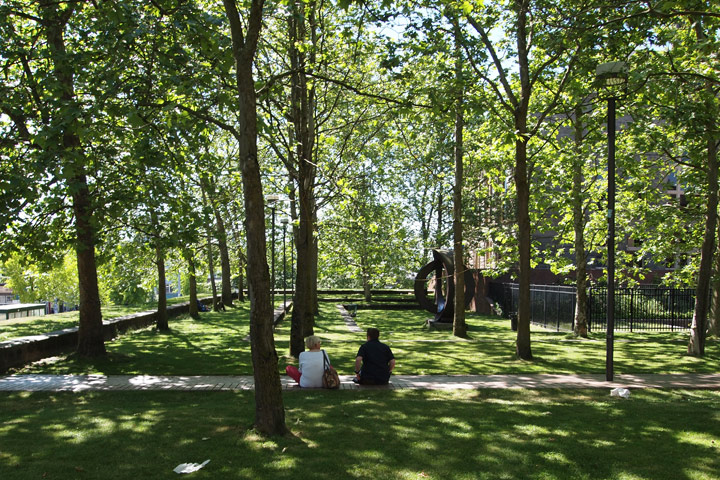
[caption id="attachment_2086" align="aligncenter" width="720" caption="Interior View Looking West"][/caption]

Topographical relief (changes in grade) is effectively utilized in the garden-plaza and provides nice seating-steps composed of both hardscape and turf. The stepping defines a sheltered place, a refuge, which combined with the shade trees to provides relief from the busy intersection and adjacent streets. Concentrically arranged, the seating-steps focus on a bronze sculpture and a children’s play area.

dappleded-light-1
dappleded-light-1

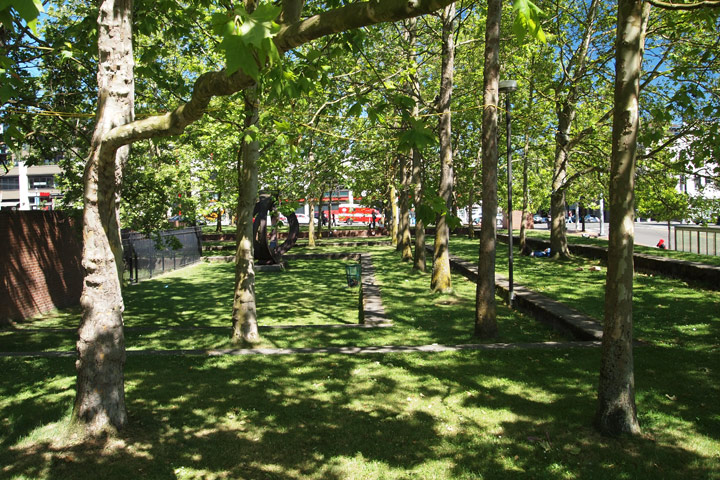
[caption id="attachment_2087" align="aligncenter" width="720" caption="View Looking East, Towards Broadway"][/caption]

A robust, rusticated wall neatly defines the landscape’s perimeter to the south and west, its materiality deftly reflecting that of the Broadway Performance Hall, just to the north (the wall was originally part of the buildings base, when it sat on the corner, prior to its being moved to its current location). On an opposite corner of the site, and at grade, wide entries welcome passersby into the landscape, and into the College, beyond. As aforementioned, sculptures (of varying levels of quality), pepper the landscape, creating points of visual interest, while another stepped-seating of turf and hardscape provides another prospect on the site northeast corner. So far, so good.

dappleded-light-3
dappleded-light-3

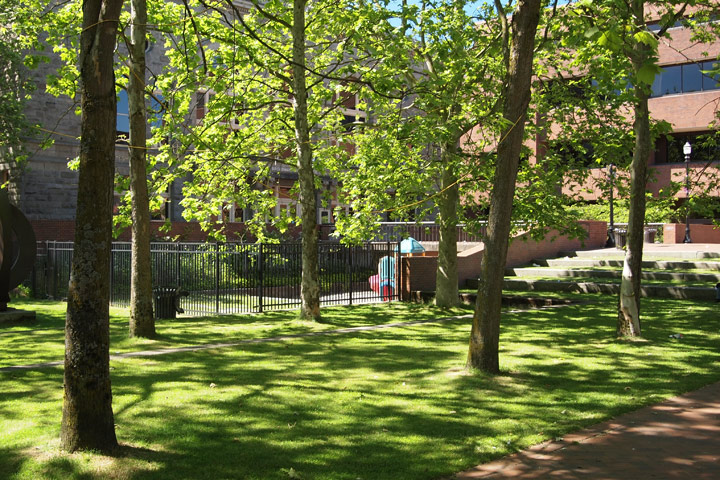
[caption id="attachment_2088" align="aligncenter" width="720" caption="View Looking North, Towards the Broadway Theater"][/caption]

As so often happens, however, the sum is lesser than of its parts; for, despite all of these apparently good qualities (taken individually), the space is a largely a failure because it is introverted and self-absorbed. Again, this would not be a bad thing, except it is adjacent to an important Capitol Hill crossroads. It is not inviting to passersby nor is it a strong landmark, two qualities it should have given its prominent location. Its relationship to its context is muddy, and in fact it denies connection to much of its surroundings. It is a public landscape by ownership only, not by perception or use.

bus-stop
bus-stop

[caption id="attachment_2090" align="aligncenter" width="720" caption="Bus Shelter and Landscape Wall Along Pine"][/caption]

The first problem with the design — if I were to order them — is the robust, architecturally appropriate wall, mentioned above. Too robust, it turns out. Too tall. Too long in its unbroken southern and western lengths, making it too daunting to surmount and gain entrance into the niceties described  above. Below, one sees the rather abrupt (and frequent) edge the wall defines. Hundreds of linear feet, I dare say, and cliff-like for more than a few of dozen of them. And what of its dutiful retention of the turf, so true to the wall’s being? Alas, it is, but too much of a burden to bear as witnessed by the diminutive Metro bus patrons (above) awaiting the 3:17 and dwarfed by, you guessed it — too much retained earth — a few too many ‘toos’, I’m afraid.

view-to-sw
view-to-sw

[caption id="attachment_2091" align="aligncenter" width="720" caption="The Southwest Corner Cliff"][/caption]

The inaccessibility delimited by the walls and grade challenges create an isolated space, an isolation furthered by the above mentioned stepped-seating, which also happens to focus inwardly. Conceptually, a contemplative space is not a bad thing, but as it focuses onto things that are not visible from the surrounding streets, it loses the opportunity  to pique the passerby’s interest and tempt entry, and populate the space. And the object of the focus: a gated playground. The playground part is fine, just not the gated part. More isolation. Less inclusive. And again, not the quality for a space at one of the most important intersections on the Hill.

view-down-broadway1
view-down-broadway1

[caption id="attachment_2089" align="aligncenter" width="720" caption="The Vacancy of Broadway along the College's Main Facades"][/caption]

On the opposite end of the too defined, too isolated spectrum of design – (both geographically and spatially)  is a space of too little definition. Yes, many of us are aware of  the expansive sidewalk betwixt SCCC and Broadway (another design issue, to tackle another day).  Not only does the expansive sidewalk damage SCCC’s frontage along Broadway, but it provides too little definition – containment – for the garden-plaza’s northeast boundary. Unlike the overly defined and inaccessible southern and western walled edges, the northeast corner spills out into a space that itself is spilling out. Double spillage? What a mess. An easy and understandable transition from one space to another is generally a positive thing in landscape, but in this case the sheer size of the Broadway sidewalk sucks the energy, the place-ness, right out of the landscape in question, and scatter-shoots it along the void that is south Broadway.

bobby-morris-diagonal

[caption id="attachment_2092" align="aligncenter" width="720" caption="And the People go on Forever . . ."][/caption]

By contrast, a mere half block away, on the same sunny, 4th of July afternoon, we have another landscape (the second of our ‘two spaces’) that is almost over-burdened by its success: the Bobby Morris Playfield. “Unfair”, “cheap shot”, some would say. “It is a different space, for different needs.” “It has a program –that designer’s crutch.” Correct the nay-sayers are, but that misses the point. Despite its quality components and its different intentions from the Playfield, SCCC’s garden-plaza does lack the niceties of program, but it more importantly lacks the most important component of any public landscape — people — which Bobby Morris has in abundance. Even participants in landscapes of repose benefit from at least a few other users near by. Keeps the space, well,  public.

Sunshine . . . that’s what the folks in the Playfield wanted! Sun and action. That is why the Playfield has people, and the SCCC landscape does not. What if the blazing sunlight and programmatic crutch of the playfield were snatched away? Would the Playfield still attract people? Hmm? Well, it would, and it did, for not quite five minutes later and 200 yards to the north, I took the photo below. In the shade. No action. Just folks relaxing. Much as they would do if they were in the SCCC garden-plaza — that is if the SCCC landscape functioned as it should and attracted them.

bobby-morris-shade
bobby-morris-shade

[caption id="attachment_2093" align="aligncenter" width="720" caption="Made in the Shade . . . ."][/caption]

So, what to do with this under-performing landscape, located at a key Capitol Hill intersection and gateway to SCCC — tear it down  and build on it. “What an architect” some would cry. Destroy a lovely landscape, and put a building there. Well, say I, I would rather spend my entire day at Volunteer Park, Cal Anderson Park, or Bobby Morris than any building on Capitol Hill, so my suggestions are not from my dark, egotistical architect’s perspective, but from a lover of public landscapes. The Broadway and Pine intersection needs the kind of strong, spatial definition provided by a building, not the vacancy provided by an underperforming landscape. And given the types of shortcomings described above, renovation is not an option.

So, let us consider replacing the lovely — but woefully underperforming — garden-plaza in its entirety, with a new hybrid-use type of SCCC building and a new, contextually relevant landscape plaza. Hybrid-use I say? Yes, for this site (and all future SCCC sites) should foster a dynamic, integrated engagement with the larger Capitol Hill community. A hybrid-use building and landscape would have, among other things, 24-hour, active uses, a transparent ground floor, and recognition and enhancement of its key location on the Hill, as well as uses outside of SCCC’s traditional educational-only ones. This hybrid-use building and landscape would provide the kind of 24 hour peopling needed (by all Hill residents) for this most important site. A tall order for an institution with a mixed history of building on the Hill, and one that will require a change of approach on their part and strong support from the community on ours; however, there is new leadership at the College, and with it new perspectives that may help achieve redefined and shared goals.

Tips on attending a conference

These are some practices I’ve developed over many years of attending conferences. They are not the only tips, or even the best tips…but they are my tips as I reflect on the conference from which I just returned. 1. Prepare Read the program descriptions beforehand (on the flight there is fine) and circle the sessions in the program guide. It’s frustrating to make quick decisions on the fly while standing in the hallway, especially if you are trying to network at the same time.

Read bios of the presenters and try to remember their names so if you sit next to one, you know who they are and can capitalize on the opportunity to introduce yourself and ask questions.

If a directory of participants is provided, scan the list to see if there are people you know or want to meet - so you can be on the look out throughout the conference.

2. Introduce yourself If you are an introvert and feel uncomfortable meeting knew people, force yourself to be extrovert for at least the first day (no one will know any different of you.) Introduce yourself to anyone/everyone around you. Look for others who may be standing solo, they will likely be welcoming of your introduction - perhaps they may be feeling the same awkwardness of not knowing anyone either. Being an extrovert for a day may dramatically improve your experience of the conference. If not, day two you can go back to being an introvert, but you may be pleasantly surprised how many people will try to engage you based on your interactions the day prior.

If you get to a session early, rather than bury yourself in your smart phone or the conference program, introduce yourself to those sitting around you. Ask how they are enjoying conference, how they learned about the conference, their connection to the topic, etc.

3. Become an expert Sit near front or middle of any session. During the Q&A period, ask questions or make a comment – but remember it’s about the quality (vs. quantity) of your comments. One or two questions/comments is enough define yourself as expert – there is a fine line between coming across as an “expert” in a subject matter and a “know-it-all.”

4. Exchange business cards If applicable, on the business card you give away, write down information you are requesting of the recipient. On cards you receive, write down key words of the discussion you had or the items (weblinks, articles, book titles, contacts) you promised to send them. This will help you tremendously when you get home and sort through the stack of business cards you collected. (there are many times when I look at cards and wonder, “what were we talking about?” or “what was it that I said I’d send to them?”

When you get home, follow up with the business cards you collected. Send email to follow up with those who promised to send you info, forward to others the info you promised to them, and send thank you notes to those with whom you had a great conversation.

5. Use Social media Tweet or post to Facebook/LinkedIn a key word or phrase that you heard, a new concept you learned, names of presenters and an interesting comment they made, etc. Blog about your conference experience – either during or shortly afterwards.

6. Build a community If you enjoyed the conference, plan to attend the following year. Put it on your calendar as soon as you hear about it so you can start to plan around it. Make vacation plans around it to capitalize on the travel expense. Invite friends and colleagues to attend the conference with you.

If you attend annually, you will start to recognize faces and develop friendships. Consider presenting – after a few years, you might identify areas where you have knowledge or relevant topics that haven’t yet been discussed.

The Italy of the Italians Part 4: Bologna and The Evolving Uses of Public Space


[caption id="attachment_1986" align="alignnone" width="700" caption="Bologna: Distant View of Famous Tower"][/caption]

As well as being home to the world’s oldest university, Bologna has many other noteworthy accolades: it is among Italy's wealthiest cities, it is a favorite destination of Italian tourists when traveling within their own country, and its population growth has been amongst the steadiest in the county. These facts, along with others, make Bologna the most dynamic of the three cities visited on the tour, and the most urban, in a contemporary sense. While there are certainly tourists in abundance, Bologna’s prosperity does not rely on their support alone; it is a national center for commercial trade fairs, publishing houses and bookstores, and academic pursuits of all kinds. It is also a fast-paced city that still maintaining the charms of its smaller Italian brethren.

[caption id="attachment_1901" align="alignnone" width="700" caption="Colonnade and Bologna's Duomo"][/caption]

Wandering the streets of Bologna, one does not get the sense the city had a zenith, or point at which its development was stalled or frozen. Its prosperity extended beyond the Renaissance, and in fact continues to this day, making it an interesting venue to take note of an evolution of the uses of public space, new urban typologies, and the changes in the private and public buildings that create them. The most obvious manifestation of this evolution is Bologna's justly famed colonnades. Kilometers of them. Over forty in total, should memory serve me correctly? While other cities have colonnades -- and Bologna certainly did not invent them -- the sheer profusion and varying character of those in the capital of Emilia Romagna is profound. They occur on nearly every street, in every neighborhood, and are made up of every traditional material imaginable. They share many similarities amongst their variety, however. They are typically one or two stories high, have arches defining their street side, and their ceilings are typically groin or arched vaults. These physical attributes are secondary to their spatial importance, for taken in toto, the colonnades create an extension of the public realm into the private -- and vice-versa -- throughout the city. This new venue enabled a finer grain of public space, and perhaps, new levels of social interaction.

[caption id="attachment_1863" align="alignnone" width="700" caption="Long Colonnade"][/caption]

Within the common traits, however, there are differences in craft and spatial definition. Those along main shopping streets are, as one would imagine, amongst the fanciest, with their adjoining buildings tempting passers-by with elegantly displayed merchandise, while those defining newer streets are straighter than those in the older parts of the city. Many of those in the university districts are decidedly plainer, even a bit tired looking, and a reflection of the disposable income of the students who frequent them. Yet no matter the use of the adjoining structure, almost every building has a colonnade, shop fronts or not, with some colonnades even occurring along blank walls.

[caption id="attachment_1942" align="alignnone" width="700" caption="Simple Colonnade"][/caption]

[caption id="attachment_1947" align="alignnone" width="700" caption="Fancy Colonnade"][/caption]

[caption id="attachment_1945" align="alignnone" width="700" caption="Colonnade Corner"][/caption]

An interesting signifier of the evolution of the colonnade can be found in their exterior designs, and how the uniformity (or lack there of) between individual colonnades untied (or did not) the street wall formed by the buildings. This change is indicative of the conception of the city as a whole, and is key to the evolution of the city in the West. In Bologna, one can see how early on colonnades varied from one building to another, with hardly a care for the design of their neighbors. As time progressed, colonnades became a great unifier of the streetscape, and were designed to the same heights and materials, regardless of the continued individual expressions of the buildings set upon them. This unified design approach marked an important step is seeing the city as a collection of desperate parts, to one where rules of decorum were established, rules of order that reflected the greater stability and confidence projected by urban dwellers in their relationships with one another and with the city itself. The city was less a place of the individual, and more the place of the collective, of the group, and in so being the architecture and the streets they defined were unified. This new, unified conception of the streetscape was a result of an ever more united political and social purpose, and the rising interrelationships between individuals as the market economy took greater hold, and the beneficiaries and drivers of that market economy – the middle class – had a greater role in defining the public realm, and its need for recognizable spaces within which for people to gather, to tend to affairs.

[caption id="attachment_1949" align="alignnone" width="700" caption="Early Colonnades"][/caption]

[caption id="attachment_1912" align="alignnone" width="700" caption="Newer Colonnades AlongVia dell'Indipendenza"][/caption]

[caption id="attachment_1948" align="alignnone" width="700" caption="Newer Colonnades Along Via dell'Indipendenza"][/caption]

A similar – yet contrary -- argument, could be made of Bologna’s contemporary, foreign, totalitarian regimes, which expended great efforts on creating unified expressions of their absolute power, their ability to control everything, including the (quasi) public realm. Yet Italy was not a unified country until the late 19th century, and though there certainly were local dukes controlling the affairs of others, their influence could not have been as great in countries such as France, where the powers of the kings was absolute, and where commerce, entrepreneurship, and trade was less important to the well being of the city as was the case in Italy. And I do not need to waste efforts to note the disastrous effects a market economy un-checked can have on cities, as found in profusion throughout the United States. But I digress.

[caption id="attachment_1909" align="alignnone" width="700" caption="Piazza Maggiore"][/caption]

Bologna’s most important public space, the Piazza Maggiore, makes use of the colonnade, and the social structure if fostered, to great success. Here, the ground floor activities of the surrounding buildings are not appendages or after-thoughts, but fully integrated uses, with the colonnade being the intermediary brokering the deal between private and public realms, and creating the necessary in-between space often crucial to seeing the grey between the black and white. Bologna’s justly famous left-of-center politics are well served by the Piazza, with open political debate occurring at all hours during our stay there.

[caption id="attachment_1866" align="alignnone" width="700" caption="Neptune Fountain"]Pontificator, Piazza San Maggiore

While certainly not unique, and probably not the first of it kind, Piazza Maggiore's splendid Neptune fountain is of a scale and conception that sets it apart, and is the strongest indicator yet of the redefinition of the piazza from a place of politics and markets to one of leisure. This formidable statue breaks in message and in execution from the previously predominant statue paying homage to a city noble man, military hero, or favorite son. It is a statue that pays homage to a mythical character meant to evoke ones fancy, not one's loyalty to the state. By depicting Neptune, the designer made direct reference to Italy's Roman past, Italy’s cultural heritage. Had it been a statue to Caesar August, the same association would have been made, but that would have been more political than cultural, and far less evocative of the new emphasis on leisure activity the piazza was now charged with. By paying homage to Neptune, cultural association is squarely the target. This statue is all about art, not politics. It is meant to be visually entertaining, and not taken too seriously (even tough it is a serious work of art). Its scale -- and its impressive base -- not only defines the space within which it was inserted, but provides ample places on which to sit and socialize. Urban furniture at its finest, and at a grand scale, placed for the pleasure (and appeasement?) of the public.

[/caption]

[caption id="attachment_1951" align="alignnone" width="700" caption="A Transparent Palazzo"][/caption]

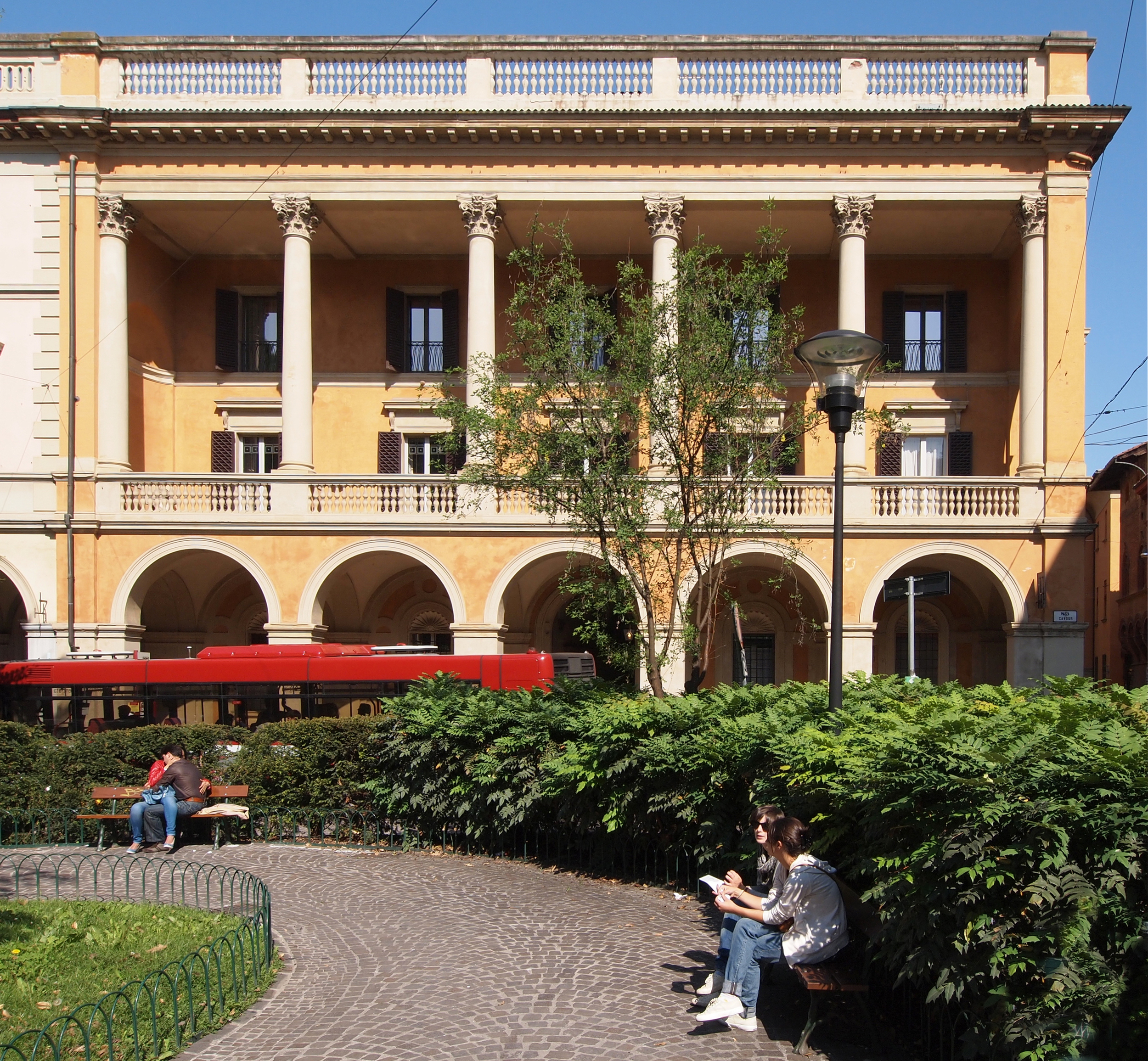
A subtler, yet equally important evolution in urban typology-evolution is in evidence in Bologna as well: that of the de-fortification of the palazzo, in which here I also include the de-fortification of (i.e. planting of) the piazza. Centuries passed between the Piazza Diamante of Ferarra (see previous post) and the palazzo pictured here. Just as the Este Dukes of Ferrara went from castello to Renaissance palazzo, the gentry of Bologna went from the Renaissance palazz0 – and its still essentially fortified demeanor -- to one of  a more refined detailing and openness. Furthering this advancement was a more substantial relationship between palazzo and piazza (now more of a garden, in contemporary parlance), which was afforded by the loggia pictured here, where the loggia gives the palazzo’s residents something pleasant to look at. Were cities becoming safer places, and fortified homes no longer needed? Perhaps. Or was it that city dwelling had evolved beyond simple survival, to expand to notions of sociability, openness, and a closer relationship with nature? Had expressing the pleasures of urban living usurped expressing merely its means of survival? The same questions (and implied answers) could be inferred by the garden in front of the palazzo. This garden is no place of business, or of authority. It is a place in which to relax, to enjoy, all actions that can doubtlessly happen in a non-planted piazza, but here the garden’s obvious use is pleasure -- not business. And the landscape is the perfect medium to make this transition, by presenting a softer image of urban living, the same as the loggia that fronts it.

[caption id="attachment_1910" align="alignnone" width="700" caption="The Two Towers"][/caption]

Bologna’s charms are not limited to academic musings of the evolving nature of urban space, for it houses many of the typically charming medieval and Renaissance qualities of it neighboring cities. The most famous of these qualities being a pair of massive towers, just outside the Piazza Maggiore. They are all that remains of perhaps dozens of such medieval structures, these two neighbors (like the one in Pisa), are a bit our of true, and unfortunately closed to visitors out of concern that the extra weight might make them collapse. The photo distorts their true sizes -- they are quite tall and massive (see the first image of the post to better sense the size of the tallest), yet are crammed within the smallest imaginable piazza. Of course, Bologna is filled with little gems of buildings, all alone, whose gem-like qualities are more so because of the contrast to the colonnaded buildings.

[caption id="attachment_1944" align="alignnone" width="700" caption="Small Chapel"][/caption]

The best of the little gems was the biggest surprise -- a little shop front by Scarpa! At least that is who I assume designed it, as it has all the requisite trademarks. What a great find it was indeed, I only wish time has permitted me to return to it and have a look inside during business hours.

[caption id="attachment_1865" align="alignnone" width="700" caption="Scarpa (?) Shop-Front"][/caption]

The changes noted above were not unique to Bologna, and the political and cultural forces that heralded them are informed speculation on my part -- informed mostly by comparing them to the previous cities visited on this tour, and on many previous ones. I will continue to explore the notions of commerce, the market place, leisure, and the political and cultural structures within which they worked formed not only these magnificent Italian cities, but moving also in our own cities, in our own time.