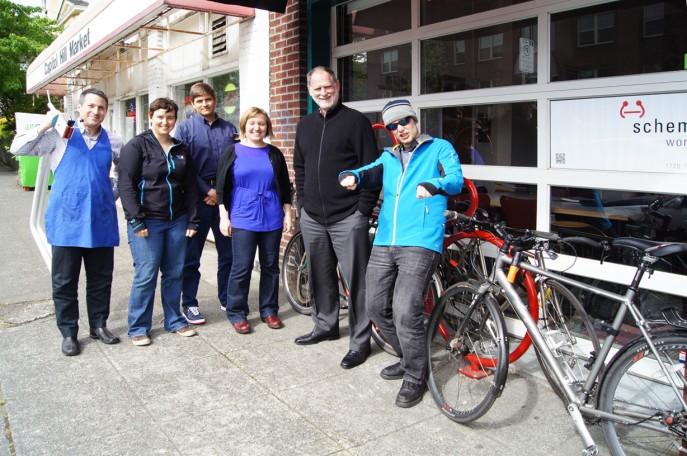
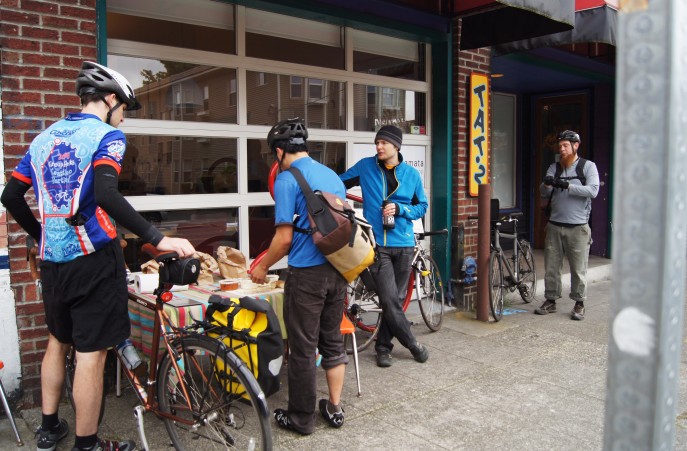
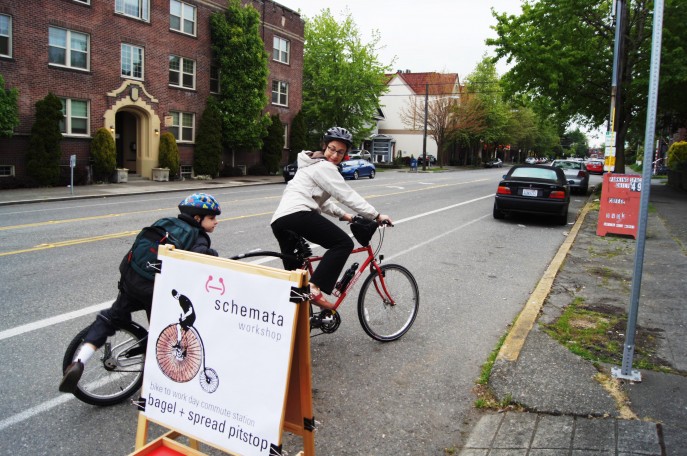
Last month Schemata hosted a small Bike to Work Day DIY Commute Station. It was a simple setup – just a table, some bagels, and some smiles. We visited with many friends and neighbors on their way to work or school on 12th Ave. In fact, it was so fun that we’ve decided to host a monthly bike-to-work bagel pit-stop at our office on the last Friday of the month during the summer! We'll be set up with a table in front of our office at 1720 12th ave next Friday the 29th from 7:00 AM to 8:30 AM. Stop by for a bagel and a chat!
Biking Bullfrogs: Bike Month in Review
Bike to Work month has come and gone, but it has made a lasting impression on the office. We regularly have more people biking to work now than ever before, and even hold the occasional bike maintenance lunch-time workshops, held by one of our founding principals, Mike Mariano.

We're already thinking about next year's Bike to Work month, and have several goals in mind:
- 100% Commute Rate.
- More office participation
- Encourage more local offices to join, and join our Capitol Hill league.
And finally, here are some Biking Bullfrog team stats:
- Trips: 88
- Miles: 465.4
- Displaced CO2: 456lbs
- Total Calories Burned: 22,803 - That's 73.5 McDonald's Cheeseburgers!
The Capitol Hill Eco-District
Tuesday night at the Broadway Performance Hall at Seattle Central Community College, and before a crowd of almost 300, Capitol Hill Housing (CHH) rolled-out its Eco-District Vision for Capitol Hill. Prepared by GGLO architects and funded by the Bullitt Foundation, the Eco-District Report (http://capitolhillhousing.org/downloads/Capitol-Hill_EcoDistrict_Report_2012.pdf) outlines a broad agenda for achieving a more sustainable lifestyle on the Hill, and by extension, Seattle and the nation. Setting ambitious -- but achievable -- goals for carbon neutrality by 2050, the Report tracks current consumption of energy and water as well as many other metrics, and sets forth steps needed to hit the 2050 target. Much of what is called for, however, goes beyond tonnage of CO2 and gallons consumption of water. What the Report calls for is really a change in our social constructs and habits. This theme was echoed by the panel discussion that followed the Report's summary presentation. Panelists included (left to right in the below image):
- Llewellyn Wells, President of Living City Block
- Mike McGinn, Seattle's Mayor
- Dennis Hayes, President of the Bullitt Foundation and founder fo Earth Day
- Naomi Cole, Eco-District Program Director, Portland Sustainability Institute
- Rebecca Saldana, Equitable TOD Program Director, Puget Sound Sage
- Ron Simms, former King County Executive and HUD Deputy Secretary (Moderator)
Supportive of the goals of the Eco-District, and presumably of the high-level summary given, the panelists engage in a lively discussion that amounted to a call for a grass-roots effort by Capitol Hill residents to implement the Reports directives. Even the former politicians on the panel noted that the actions needed to achieve a balanced, equitable, and just stewardship of the environment needs to come from the bottom up, and that in fact, politicians need our leadership and guidance to craft policy that will allow implementation of proposals such as those in the Report.
The Report and CHH's roll-out are well timed, as they came out (supposedly) less than six month's from the date that Sound Transit says they will release the Request for Proposals (RFP) for the Capitol Hill station's TOD development sites. The sites, which figure prominently and are in fact the literal center of the Report's maps, present the best early opportunity for furthering the Report's goals as they will be the largest single assembly of adjacent private development parcels likely to hit the market for the foreseeable future, and are in fact large enough to realize many of the economies of scale required for implementing the Report's strategies. How the Eco-District Report figures into the development TOD parcels are yet to be seen, but there is no doubt that the vision of the Report and the best interests of the community will be served by developers who are responding to the RFP that have both a proposal and track record that testifies to an ability to make the TOD Capitol Hill's first significant contribution to our Eco-district goals.
Harrison Modern -- Funky Mid-Century Modern that Speaks to Today
I have been riding my bicycle past the Harrison Modern for almost a decade now, always appreciative of its design and one that I have been yearning to share for some time. Unfortunately, its predominant exposure faces north, making its photography less than ideal for a majority of the year and thus potentially depriving the building the adoration it so deserves. Imagine my great joy when, a couple of weeks back, I was walking past in the late afternoon -- camera in hand -- with the lighting just perfect for portraying the Harrison's many charms.
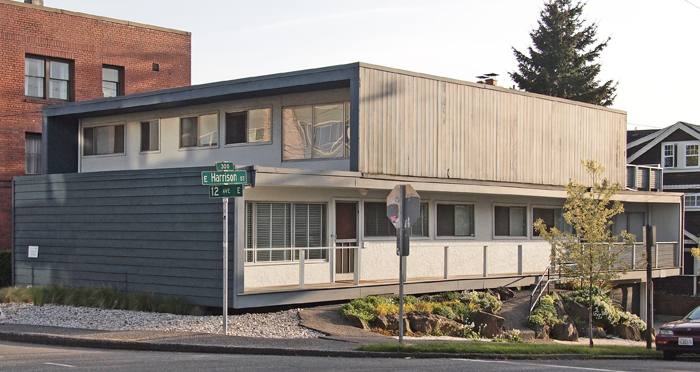
Located at the intersection of 12th and Harrison, the Harrison Modern is clearly a building whose designers were firmly rooted in mid-century modernism. Built in 1951 and designed by Victor Martin, the Harrison is not only exemplary of that era, but it also foreshadows current trends in architectural design in its use of layered cubic forms as exemplified by the work of such contemporary Dutch architects as MVRDV in the Edificio Celosía, pictured below. This stacking design approach, though all the rage now, was most certainly pretty avant-garde over 60 years ago, and continues to mark the Harrison unique among Capitol Hill's vintage buildings.
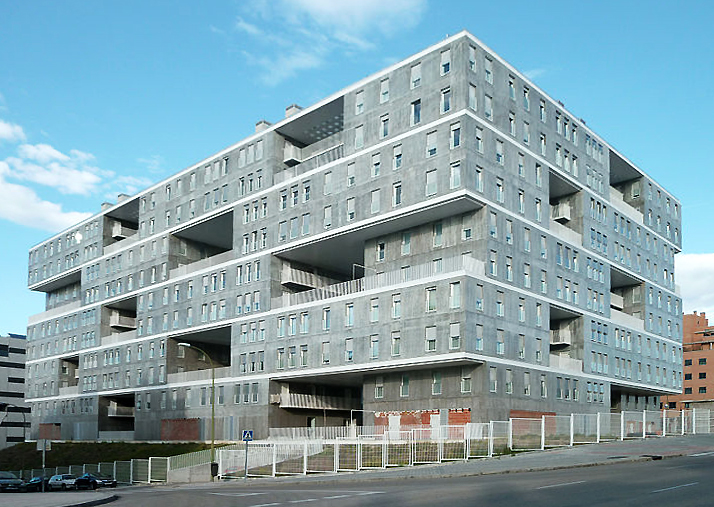
What I am calling a stacked or layered design is one where each floor (or grouped floors) is expressed individually and in a very like manner, without the more traditional base, middle, and top. In both the Harrison and MVRDV example, this stacking is expressed not only by revealing the floor lines, but also by carving out voids for balconies that emphasize the volume of the floors above or below. The Harrison's design captures this layered design approach to create cleverly framed outdoor spaces that exhibit the modernist desire forblending indoor and outdoor space, including a generous upper floor balcony that must provide a great view of the Puget Sound and Olympic Mountains. On a more intimate scale, the north facing veranda of the Harrison is crisply framed, forming a powerfully simple, elegant, and dignified facade along Harrison Street.
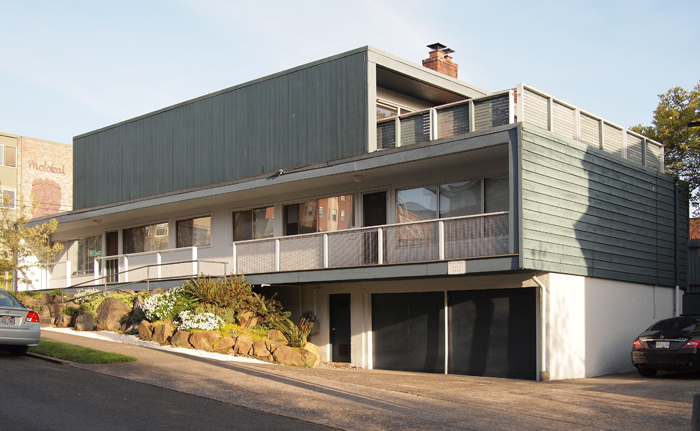
Along 12th Avenue, the busier of the two streets upon which the Harrison is sited, a more formal facade was in order and is fittingly more massive in temperament. The contrast, and utility between, these three elevations is achieved by the simple rotating of the lower and upper floors to best suite their orientation, an ease of effort to effect that has long captivated me. A powerful difference is accorded between the two floors; on the longer, northern elevation is the lower form which represents the void, and on shorter, eastern elevation, it is the upper form. A lower floor ying to the upper floor yang, as it were.
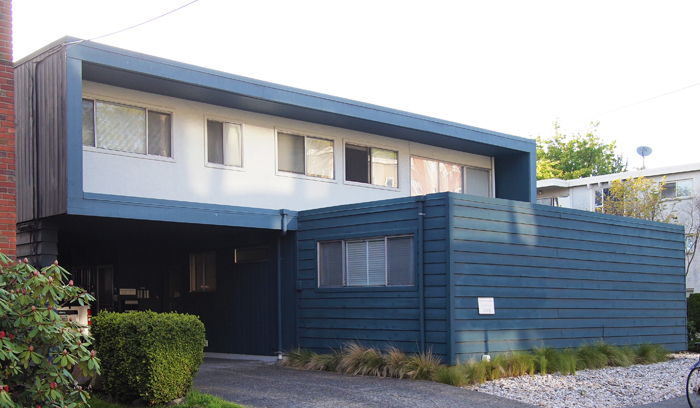
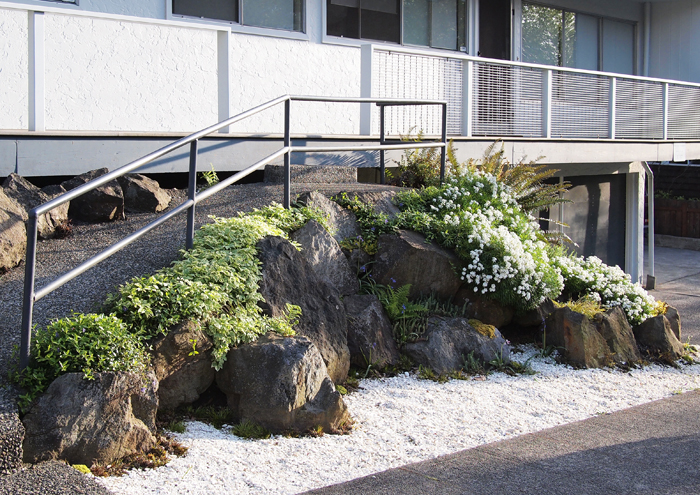
Contrasting the bold cubic forms above are the cascading stones and plantings that mark the entry ramp into the building. While on one level apparently quite different form the building's aesthetic, this little bit of landscape is actually within the spirit of its mid-century heritage, and provides a finishing touch to one of Capitol Hill's finest small buildings. If I squint a bit, I can imagine the Harrison at home in say, Palm Springs or Malibu, but am quite content knowing it is our neighborhood.

Bike to Work Day!
Our DIY Bike Station was a great success! Many friends and neighbors stopped by to say hello and grab a tasty bagel and spread. Domonique and James staffed our little 'booth' and dispensed carbohydrates to the hungry biking masses. Seattle has a great and growing cycling culture. All sorts of folks stopped by, from city planners to parents dropping of their kids at school. Thanks to all!