Modular units set in place for Renton Housing Authority

In May, over 4 short days, the Kirkland Avenue Townhomes were set in place. We are working with Frazer Pogue Collective to create a video telling the larger story of why affordable housing and modular homes are a perfect match. Look for the film debut in October. In meantime, here's a 30 second trailer to give you an idea of the set in process.

Schemata Workshop + Champion Homes + Renton Housing Authority In May we were contacted by Schemata Workshop to film the installation of modular units and tell the story of why affordable housing and pre-fab are a perfect match. We spent multiple days in Renton filming and captured conversations with Schemata's Founder, Grace Kim and Shelter Resources' Joel Ing. Stay tuned as we continue to visit the construction site and talk with key players before debuting the film in October. www.schemataworkshop.com Music: Charlie Bisharat more films at: www.frazerpogue.com

Modular buildings for Renton Housing Authority take shape.

For a little over a year now, Schemata Workshop has been working with Renton Housing Authority (RHA), Shelter Resources, and The City of Renton in the development of 18 units for The Renton Housing Authority.  The entire development of Kirkland Avenue Townhomes incorporates progressive building and environmental strategies that are new to the city and RHA.  On site there are stormwater maintenance strategies putting rain gardens/bioswales in the public right of way. Specific to the topic of this post, modular building strategies are used to create efficiency and regularize the quality of the finished product.


Many misconceptions surround the delivery method of modular building.  Outside the modular building industry people are familiar with Structurally Insulated Panels (SIPs) or the ubiquitous mobile homes. In contrast, the way we will use modular construction will be completely indistinguishable from site built construction.  Kirkland Avenue Townhomes will be built of a system of fully finished module blocks, about the size of a shipping container, that are replete with all finishes, plumbing, toilets, windows, etc.  These modules are delivered to the site, craned into place, strapped together, and then the roofed in a matter of weeks.  

Building projects modularly has its advantages over site built construction.  The factory environment eliminates outside elements, minimizing rain and water damage, as well as the mold and health issues that can accompany them.   It holds the potential to speed up construction since disparate trades can work concurrently.  For instance, currently on site in Renton, Pavilion Construction, the General Contractor, is finishing up the foundation while Champion Homes, our Modular Subcontractor, is framing and plumbing walls.  This overlap can shorten construction time which not only reduces costs of construction but allows the Renton Housing Authority to place tenants faster. 

Champion Homes has developed a very efficient process in their factory line. The floor of the module moves continuously from bottom left up, when it is craned onto rollers where it moves down the line.  Other elements, such as the walls and the ceiling are framed alongside the line, and craned onto the floor as they are finished.  Many processes are different from standard construction, since there is no concern of weather affecting, or damaging, interior finish materials, work that typically must wait for the building to be dried-in happens concurrently to structural framing.  This not only changes sequencing, but also changes how details are executed.

Follow our upcoming blog posts to see the townhomes under construction at the Champion factory in Weiser, Idaho.

Bike to Work Day 2014 Bagel Pitstop

Schemata Workshop is once again hosting a diy commute station for bike to work day!  This year, Eltana Bagels has graciously donated yummy bagels and Café Argento will be supplying coffee for the morning bike commute.  Come chat with our fellow bike mavens and find out more about our bike-related design projects!

date:  friday, may 16, 2014 - 7-9am

Past posts about Bike to Work Day:

Bike to Work Day 2013

Bike to Work Day 2012


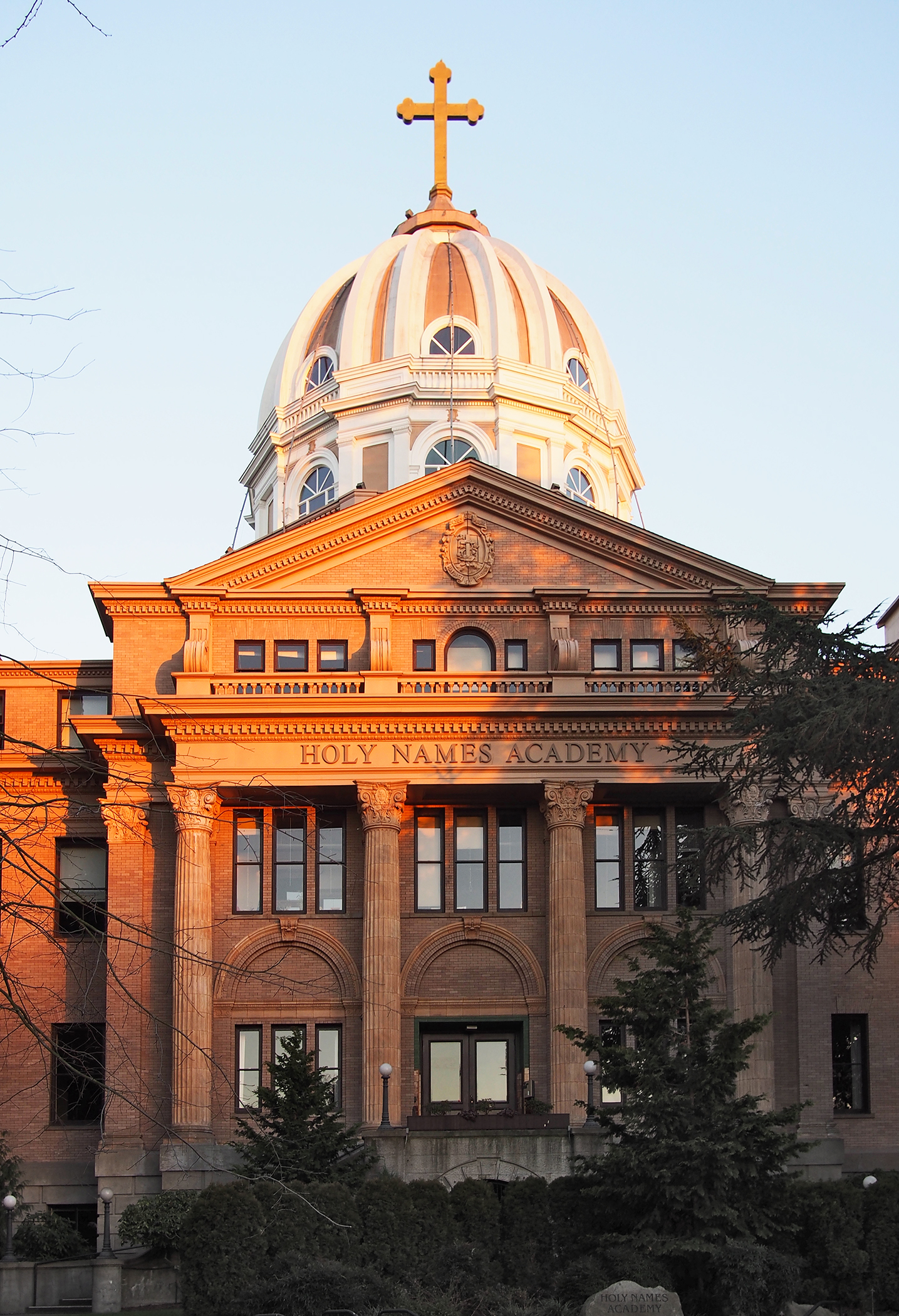
Holy Names' Dome

For over 2000 years, the dome has held a privileged position in Western architecture. As the three dimensional expression of the circle, whose geometrical perfection is venerated by cultures world-wide, the dome symbolizes importance more than any other single architectural feature. One of the oldest domes --- and perhaps the most famous -- is the Pantheon in Rome, a temple built during the reign of Caesar Augustus (63 B.C. - 14 A.D.) in honor of twelve of Rome's most important deities. Since then, the geometrically powerful form has lent its geometrical purity to convey importance to a variety of institutions, be they governmental (the Washington State Capitol, Olympia), academic (the Rotunda, the University of Virginia), or ecclesiastical (Saint Peter's, Rome). And, why not? You see a dome on a building, and you know it means business.

Interior of the Pantheon, 16th Century

Interior of the Pantheon, 16th Century

One institution that was an early adopter of the dome was the nascent Catholic Church; and the dome, as it turned out, was conveniently at hand. Soon after Rome's decline, the Church adopted the Pantheon as a Christian place of worship, and it became an important early church. The Pantheon (and the cache of its dome) enabled the Church to associate itself with ancient Rome, Europe's grandest civilization and greatest engineer-architects. In the following millennia, the dome has found home atop many Catholic instituions in dozens of countries, including Capitol Hill's own Holy Names Academy, a Catholic girl's high school and one of our neighborhood's  most splendid buildings. And while its dome may be the first architectural element to catch one's eye, Holy Names' classically inspired delights continue throughout its original building.

Holy Names' Dome

Holy Names' Dome

Although I have only cited Roman influences for Holy Names,  any such reference must recognize the Roman's heritage of Greek ideals of symmetry, proportion, and balance, and that a mastery of these principals was essential to executing good design. Simply put, geometry formed both the intellectual and artistic foundation of their cosmos, and what has since become known as classical design. The classical system of design was so refined and rigorous, that, although I could not write of the exact geometrical relationships of the parts to the whole that govern much of Holy Names' design, just one look at the bulding leads me to believe that the designers nailed it. The Corinthian columns of the portico, in not only their individual scale of capital to shaft, but also of their interrelationship to one another as well as to the pediment -- and of these elements to the dome and the entire building -- reveals the hand of someone well versed in the classical precedents that inspired them.

The Dome and Portico

The Dome and Portico

The Exterior of the Chapel

The Exterior of the Chapel

Remembering that this is a high school (a building type I dare say did not exist in ancient times), and that Holy Names' classically-inspired precedents mostly lend themselves to the exterior, much of the interior is what one may expect of a Seattle high school building of this vintage. Classrooms arrayed along long corridors with period-specific walnut wainscoting, transom windows above the doors, and shoe-box shaped instructional spaces. There are, however, a few surprising interior spaces that differentiate this high school from its secular sisters. The most noteworthy is the Chapel located in the northwest corner of the building, as there is little to divulge its presence from the outside. While more Italian Renaissance inspired than purely classical, it follows in the best traditions of chapels one may find in Apennine Peninsula. Quiet at the time of my visit, I was assured by my docent that its beauty was well appreciated by the students, be they current or past; the chapel being a popular and suitable venue for alumnae weddings. Note the columns defining the side aisles and supporting the gallery, the design governed by those same codified rules as that of the aforementioned exterior.

The Chapel

The Chapel

Another surprise came when I learned that when originally founded, Holy Names housed many of its students in rooms that have since become faculty offices. At a population of faculty and staff that currently exceeds 800, the number of young ladies living in the building was most likely small compared to today's overall daily enrollment, but their presence must have lent the building and grounds a slightly different, and more lively character. Much like the exterior, arches and classical columns populate the interior spaces; for example, in both the entry foyer and the library. In the library the arches spring from beams that are used to span the relatively large space, adding a nice rhythm and ordering system that is reflected by the placement of the windows and of the bookshelves.

The Former Dormitories

The Former Dormitories

The Library

The Library

All of Holy Names' grandeur would be diminished were its building and grounds not meticulously maintained. Sure, attendance at the school comes at a premium that affords the funds to care for the campus, but that should not impair one's ability to enjoy it. As a neighbor to the building and grounds for over ten years, I appreciate having it close at hand, its manicured lawns and huge elms as accessible to me as to her students, adding to Capitol Hill an unexpected and graceful campus to our catalog of great architecture and landscapes.