modular construction

Looking back: final steps in modular construction of the Kirkland Avenue Townhomes

A few months ago Schemata Workshop blogged about the process of modular construction. We took you through the first 7 stations of the process, (please see A Detailed Look). Now that families are moving into the townhouses in Renton, we'd like to show you the final steps involved in modular construction at the factory.

Station 8 | Ceiling Install

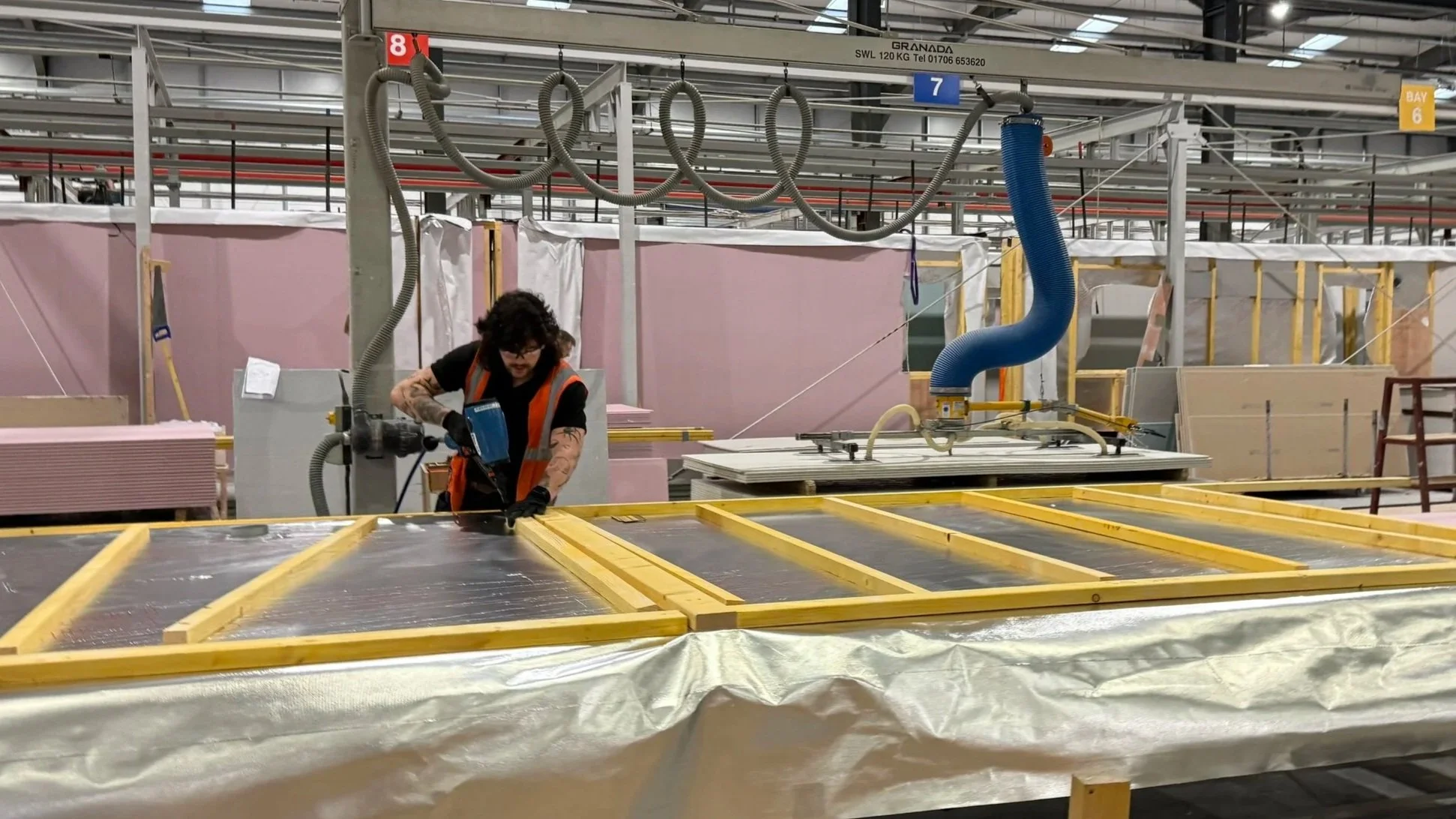
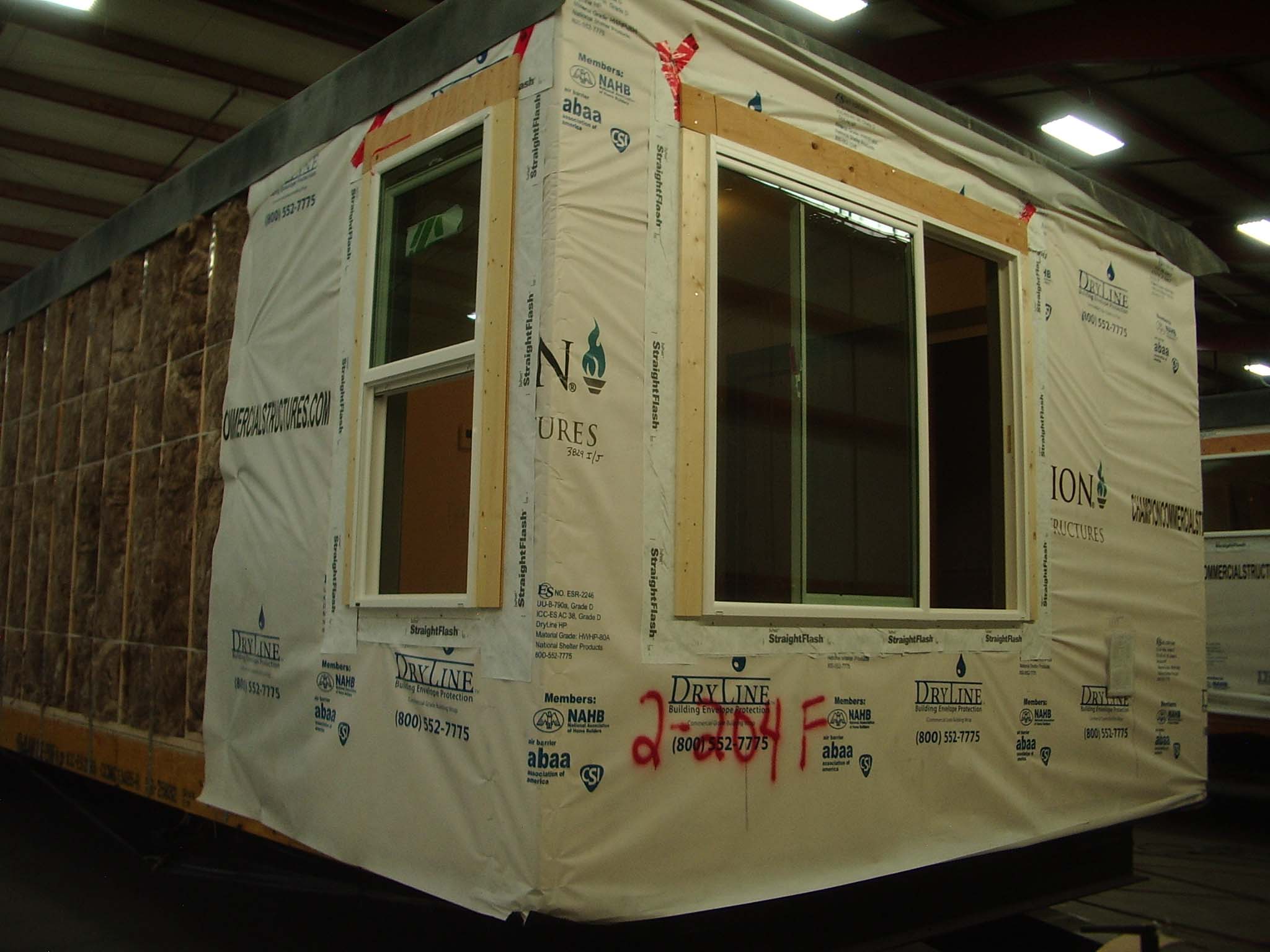
By station 8 you can see the ceiling is installed and all pertinent weather resistant barriers are in place on the roof and the exterior walls. We’re ready to begin focus solely on the interior finishes.

By station 8 you can see the ceiling is installed and all pertinent weather resistant barriers are in place on the roof and the exterior walls. We’re ready to begin focus solely on the interior finishes.

Station 9 | Finishing of Drywall

Interior Drywall is finished, taped and sanded in station 9.  The walls are painted at this point, prior to the majority of finishing of carpentry, plumbing and electrical fixtures.

Interior Drywall is finished, taped and sanded in station 9.  The walls are painted at this point, prior to the majority of finishing of carpentry, plumbing and electrical fixtures.

Station 10 | Finish Carpentry and Plumbing

Key finish carpentry elements and plumbing assembly is done off line in stations.  Here a plumber assembles plumbing fixtures to their countertops offline.

Key finish carpentry elements and plumbing assembly is done off line in stations.  Here a plumber assembles plumbing fixtures to their countertops offline.

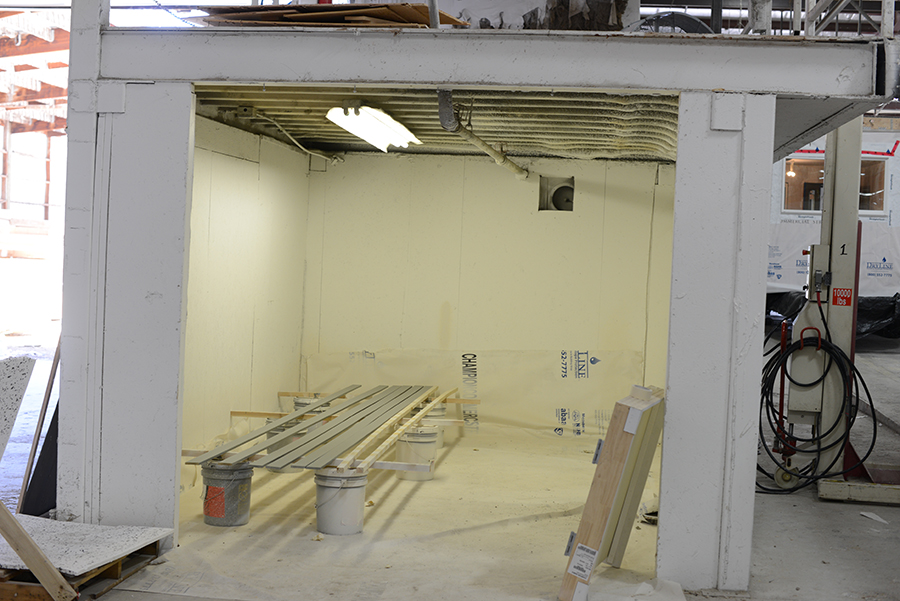
In a separate paint booth finish trim for base, door and windows is painted

In a separate paint booth finish trim for base, door and windows is painted

Station 11 | Trailor Bed

At this point, the entire module is placed onto a trailer bed.

At this point, the entire module is placed onto a trailer bed.

Careful attention is given to ensure that the module is set squarely on the trailer so the load is fully balanced during transport.

Careful attention is given to ensure that the module is set squarely on the trailer so the load is fully balanced during transport.

Given the layout of the factory floor, the entire trailer is driven up onto skids so the module can travel perpendicularly on the factory floor.

Given the layout of the factory floor, the entire trailer is driven up onto skids so the module can travel perpendicularly on the factory floor.

Station 12 | Door, Lighting Fixtures and Upper Cabinetry Install

Doors are hung on their jambs and the upper cabinets are installed.  At this time the electrical fixtures are installed.

Doors are hung on their jambs and the upper cabinets are installed.  At this time the electrical fixtures are installed.

Station 13 | Appliances and Shipment protection.

Appliances are installed and the units are almost ready for shipment.  Protection board is placed over any surface that could possibly incur damage during shipment or subsequently during the on site button up.

Appliances are installed and the units are almost ready for shipment.  Protection board is placed over any surface that could possibly incur damage during shipment or subsequently during the on site button up.

On that note, here you can see the missing drywall that was intentionally left off to allow for first floor to second floor plumbing connections.  This section of drywall would need to be finished in the field.

On that note, here you can see the missing drywall that was intentionally left off to allow for first floor to second floor plumbing connections.  This section of drywall would need to be finished in the field.

Station 14 | Shrink Wrapping

Like a boat, the units are covered in a shrink wrap material  Here a blow torch applies heat to seal the units up for shipment.

Like a boat, the units are covered in a shrink wrap material  Here a blow torch applies heat to seal the units up for shipment.

Station 15 | Shipment

The boxes are brought out of the factory and await pickup to be shipped to their final destination, Renton, Wa.

The boxes are brought out of the factory and await pickup to be shipped to their final destination, Renton, Wa.

Site 1 | Staging

The modular boxes which were shipped with both first and second floor modules sharing a common top and bottom rim joist.  These larger boxes were stored off site in a staging lot. On the staging lot, the two boxes are sawn apart and a…

The modular boxes which were shipped with both first and second floor modules sharing a common top and bottom rim joist.  These larger boxes were stored off site in a staging lot. On the staging lot, the two boxes are sawn apart and as such these types of modules are called sawboxes.  Once split into separate modules, the boxes are transported on a smaller trailer bed a short distance to the construction site.

Site 2 | Craning

A 250-ton crane was used to lift the boxes onto the foundation.  Special rigging is used and the crane location, and size, was dictated by existing power lines on site. 

A 250-ton crane was used to lift the boxes onto the foundation.  Special rigging is used and the crane location, and size, was dictated by existing power lines on site. 

Site 03 | Fireproofing and Structural Straps

As the boxes come along a separate crew follows up and places batt insulation, shown here in yellow, the insulation acts as a fire/smoke separation between units.  Additionally, crews mechanically attach straps which structurally tie the m…

As the boxes come along a separate crew follows up and places batt insulation, shown here in yellow, the insulation acts as a fire/smoke separation between units.  Additionally, crews mechanically attach straps which structurally tie the modules to the foundation and to each other.

Site 04 | Fine Tuning

As the boxes are set, the Set Contractor uses a come-along winch to fine tune the stack between first and second boxes.  Once the box is finely adjusted the crane releases all weight.

As the boxes are set, the Set Contractor uses a come-along winch to fine tune the stack between first and second boxes.  Once the box is finely adjusted the crane releases all weight.

Site 05 | Weather proofing

Once the boxes have been set, the construction takes on a more typical construction process. The air barrier is seamed together at all gaps between modules, all while the roof trusses are set atop the second floor modules.  Once the trusse…

Once the boxes have been set, the construction takes on a more typical construction process. The air barrier is seamed together at all gaps between modules, all while the roof trusses are set atop the second floor modules.  Once the trusses are in place, the roof is sheathed, papered, and shingled.

Site 06 | Insulation and Siding

Continuous exterior insulation is installed and the siding goes on shortly thereafter. 

Continuous exterior insulation is installed and the siding goes on shortly thereafter. 

Finishing touches such as awnings, gutters, and downspouts are installed.

Finishing touches such as awnings, gutters, and downspouts are installed.

Site 07 | Completion

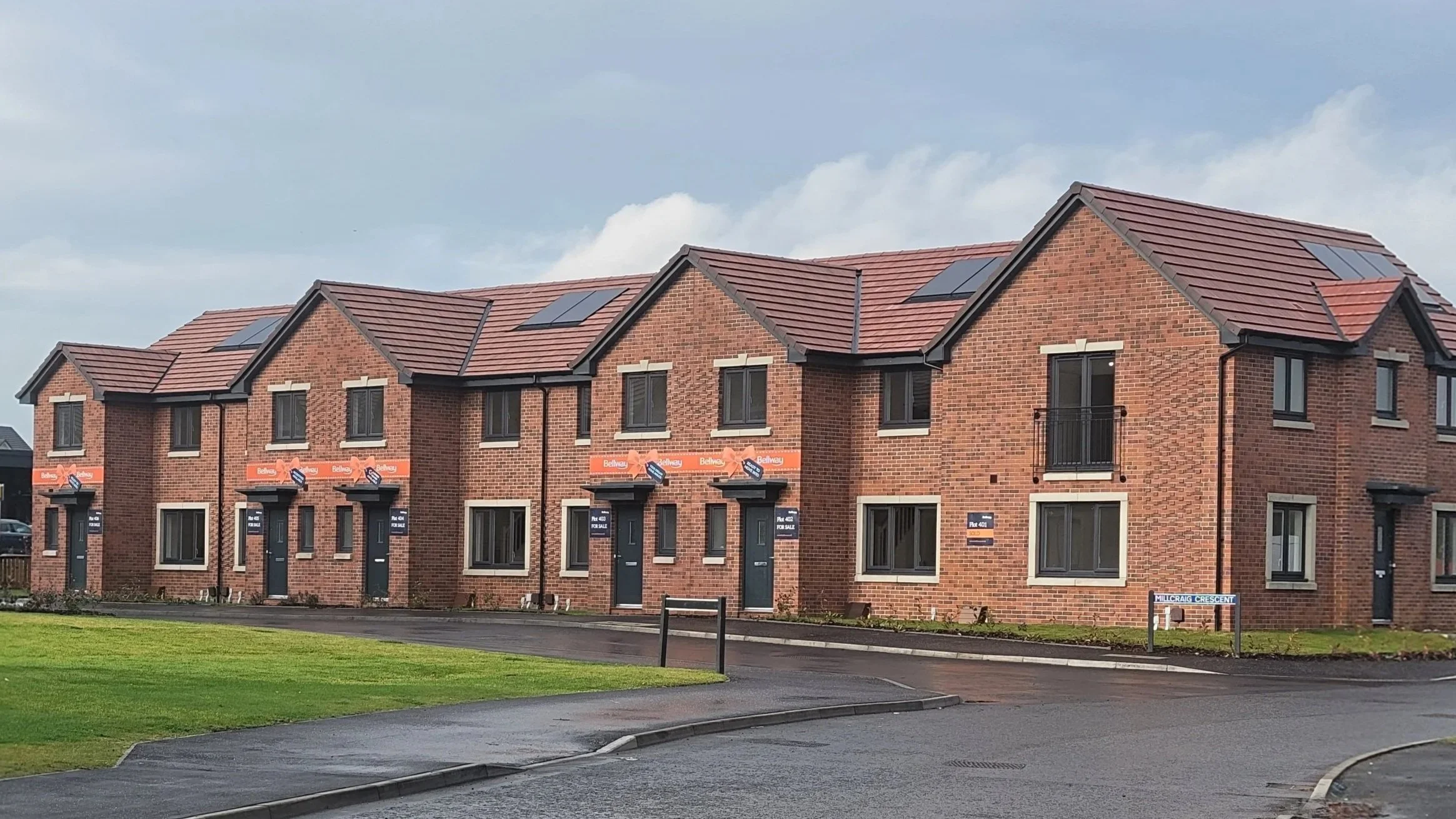
A couple of coats of exterior paint and plenty of site work and the project is finished!

A couple of coats of exterior paint and plenty of site work and the project is finished!

Kirkland Avenue Townhomes featured by HUD Washington

We've been documenting our process of creating Renton Housing Authority's Kirkland Avenue Townhomes since the beginning. As the first modular, multi-family housing project in Western Washington, it's an important step not only for Schemata Workshop, but for our partners at Renton Housing Authority, and for the Seattle area as a whole. Now that the Townhomes are complete, they're starting to get noticed! The ribbon cutting was attended by many, including Senator Hasegawa, and the Sunset Terrace revitalization has now garnered attention from HUD Washington. An article came out today that features the Kirkland Avenue Townhomes as a good example of the amazing progress happening in Renton's affordable housing sector. Click the image below to read the full write-up.

Modular buildings for Renton Housing Authority take shape.

For a little over a year now, Schemata Workshop has been working with Renton Housing Authority (RHA), Shelter Resources, and The City of Renton in the development of 18 units for The Renton Housing Authority.  The entire development of Kirkland Avenue Townhomes incorporates progressive building and environmental strategies that are new to the city and RHA.  On site there are stormwater maintenance strategies putting rain gardens/bioswales in the public right of way. Specific to the topic of this post, modular building strategies are used to create efficiency and regularize the quality of the finished product.


Many misconceptions surround the delivery method of modular building.  Outside the modular building industry people are familiar with Structurally Insulated Panels (SIPs) or the ubiquitous mobile homes. In contrast, the way we will use modular construction will be completely indistinguishable from site built construction.  Kirkland Avenue Townhomes will be built of a system of fully finished module blocks, about the size of a shipping container, that are replete with all finishes, plumbing, toilets, windows, etc.  These modules are delivered to the site, craned into place, strapped together, and then the roofed in a matter of weeks.  

Building projects modularly has its advantages over site built construction.  The factory environment eliminates outside elements, minimizing rain and water damage, as well as the mold and health issues that can accompany them.   It holds the potential to speed up construction since disparate trades can work concurrently.  For instance, currently on site in Renton, Pavilion Construction, the General Contractor, is finishing up the foundation while Champion Homes, our Modular Subcontractor, is framing and plumbing walls.  This overlap can shorten construction time which not only reduces costs of construction but allows the Renton Housing Authority to place tenants faster. 

Champion Homes has developed a very efficient process in their factory line. The floor of the module moves continuously from bottom left up, when it is craned onto rollers where it moves down the line.  Other elements, such as the walls and the ceiling are framed alongside the line, and craned onto the floor as they are finished.  Many processes are different from standard construction, since there is no concern of weather affecting, or damaging, interior finish materials, work that typically must wait for the building to be dried-in happens concurrently to structural framing.  This not only changes sequencing, but also changes how details are executed.

Follow our upcoming blog posts to see the townhomes under construction at the Champion factory in Weiser, Idaho.